In the competitive talent market of 2026, your application process is the first critical test of your company's culture, efficiency, and respect for its people. A clunky, impersonal, or confusing application experience is a silent revenue killer, driving away top-tier talent before you even know they exist. If your hiring funnel feels more like a leaky bucket than a magnet for qualified applicants, you’re not just losing candidates; you're losing a competitive edge. The root of the problem often lies in outdated, friction-filled processes that fail to meet modern expectations for speed and transparency.
This article moves beyond generic advice to provide a prioritized roundup of 10 actionable candidate experience best practices that recruiting teams are implementing today. We will cover specific, high-impact strategies designed to transform your hiring process, from adopting mobile-first conversational interfaces to providing radical transparency about your timeline and data handling. Each point includes concrete examples, implementation steps, and key metrics to help you measure success and demonstrate ROI. By rethinking your approach, you can stop qualified individuals from abandoning their applications midway through.
To truly fix a leaking hiring funnel and ensure no top talent slips away, exploring effective sales funnel automation strategies is paramount, turning your recruitment process into a sophisticated, efficient system. The following best practices will give you the framework to build a candidate journey that not only converts but also impresses the high-caliber professionals you need to hire. Let's dive into how to plug the leaks and create a powerful talent pipeline.
1. Mobile-First Conversational Interface Design
Traditional, multi-field job application forms can feel overwhelming and impersonal, especially on mobile devices where the majority of candidates start their job search. A mobile-first, conversational interface design flips this model by presenting the application process as a friendly, one-question-at-a-time chat. This approach significantly reduces friction and cognitive load, mirroring the intuitive nature of text messaging.

By turning a static form into a dynamic conversation, companies can dramatically improve application completion rates. For instance, using a tool like Formbot allows you to build a chat-based application that guides candidates through each step with a warm, human-like tone. This method is not just for applications; it's a core component of modern candidate experience best practices, making the first point of contact feel engaging rather than transactional.
How to Implement Conversational Design
Adopting a conversational approach is straightforward and yields immediate benefits for candidate engagement.
- Keep Questions Singular and Concise: Ask for one piece of information at a time. Instead of a single page with "First Name," "Last Name," and "Email," a conversational form asks each question sequentially.
- Use Natural Language: Swap formal, corporate jargon for friendly, conversational language. For example, use "What's your full name?" instead of a "Full Name" field label.
- Show Clear Progress: Implement progress bars or step counters (e.g., "Step 3 of 5") to manage expectations and motivate candidates to finish.
This interactive format respects the candidate's time and attention, creating a positive first impression. To dive deeper into the mechanics, you can learn more about conversational form design best practices.
2. Intelligent Field Extraction and Contextual Questions
A one-size-fits-all application process creates unnecessary friction by asking every candidate the same set of questions, regardless of relevance. Intelligent field extraction and contextual questions solve this by using AI to create a dynamic, personalized application path. This technology analyzes a candidate’s free-text responses, extracts key information like names or years of experience, and uses that data to ask only the most relevant follow-up questions.
This adaptive approach makes the application feel less like a rigid form and more like an intelligent conversation. For example, if a candidate mentions having a specific certification, the system can dynamically ask for the expiration date, a question it would skip for a candidate who doesn’t have it. This level of personalization is a cornerstone of modern candidate experience best practices, demonstrating that you respect the applicant's unique background and time.
How to Implement Intelligent Questioning
Adopting a smart, contextual approach streamlines the application process and provides a superior experience.
- Map Candidate Journeys: Start by outlining the most common applicant paths and create decision trees. For instance, if a role requires a driver's license, build a logic branch that only asks related questions if the candidate answers "Yes."
- Leverage AI for Extraction: Use tools that can intelligently parse unstructured text. A candidate might type, "I have over five years of sales experience," and the system should be able to extract "5 years" as the answer to a "Years of Experience" field without needing a separate, rigid input.
- Include Confirmation and Correction: Always give candidates a chance to review and edit extracted information before final submission. This builds trust and ensures data accuracy. For example, display a summary like, "Great, so your email is [email protected]. Is that correct?"
By tailoring the journey to each individual, you gather more accurate information while making the process faster and more engaging for every applicant.
3. Real-Time Visibility into Required vs. Optional Fields
Nothing frustrates a candidate more than investing time in an application only to be blocked by an unexpected required field. Providing real-time visibility into which fields are mandatory versus optional sets clear expectations from the very beginning. This transparency respects the candidate's time by showing them exactly what information is needed to proceed, preventing surprise roadblocks that often lead to abandonment.
By making this distinction immediately apparent, you reduce cognitive friction and build trust. Candidates can quickly assess the effort required and decide whether to proceed, rather than getting halfway through and feeling misled. This is a cornerstone of user-centric design and a critical element of modern candidate experience best practices. It transforms the application from a guessing game into a straightforward, predictable process, improving both completion rates and candidate sentiment.
How to Implement Field Transparency
Clearly communicating requirements is a simple yet powerful way to enhance the application flow and show respect for candidates' time.
- Provide an Upfront Summary: Before the candidate even starts, display the total number of required fields. This manages expectations and provides a clear scope of the task ahead.
- Use Consistent Visual Cues: Employ clear and consistent indicators, like an asterisk (*) or a "Required" badge, next to mandatory fields. Ensure optional fields are also clearly marked or left unmarked by default.
- Show Progress on Required Fields: A progress bar that tracks completion of only the mandatory fields can be highly motivating. It focuses the candidate on the essential information needed to submit their application successfully.
This approach demonstrates a commitment to a transparent and respectful hiring process, ensuring candidates feel informed and in control from the first click.
4. Instant Sharing and Zero-Friction Form Deployment
The speed at which you can connect with a potential candidate is a critical competitive advantage. Instant sharing and zero-friction form deployment eliminate the technical barriers and delays traditionally associated with distributing job applications or feedback surveys. This approach means you can create a form and immediately generate a shareable link, requiring no hosting, website embeds, or complex IT involvement from your side or the candidate's.
This immediacy is crucial for high-volume or time-sensitive recruiting. By using a tool like Formbot, you can build a conversational application and share it via a direct link in job postings, social media, or direct messages in seconds. This method is a cornerstone of modern candidate experience best practices because it removes friction for both the recruiter and the applicant, ensuring opportunities are accessible the moment they become available.
How to Implement Instant Sharing
Making your application and feedback forms instantly accessible is simple and can significantly accelerate your hiring pipeline.
- Generate a Direct Link: Once your form is ready, use the platform's built-in sharing feature to generate a unique, public URL. This is a common feature in modern form-building tools.
- Use URL Shorteners: For cleaner presentation on social media or in print, use a URL shortener like Bitly to create a branded, memorable link to your application form.
- Distribute Across Multiple Channels: Share the link wherever your candidates are: on LinkedIn, in email campaigns, via QR codes at career fairs, or through text message outreach.
- Create Branded Landing Pages: Host your shared form on a simple, branded landing page that includes the job description and company information to provide context and reinforce your employer brand.
This strategy ensures that when a great candidate is ready to apply, there are no technical roadblocks standing in their way, creating a seamless and positive interaction.
5. Transparent Data Handling and Privacy-First Design
In an era of increasing data sensitivity, candidates are more conscious than ever about how their personal information is collected, used, and stored. Transparent data handling and a privacy-first design are no longer optional extras but foundational elements of a trustworthy hiring process. This approach involves clearly communicating your privacy policies, obtaining explicit consent, and building your application systems with security as a core principle, which is essential for building candidate trust from the very first interaction.

Failing to be transparent can lead to high application abandonment rates as candidates hesitate to share information with a company they don't trust. This commitment to privacy is a key component of modern candidate experience best practices, ensuring compliance with regulations like GDPR and CCPA while showing respect for applicant data. When designing your systems, it's crucial to transparently communicate data handling practices; you can review a privacy policy example to see how this can be structured effectively.
How to Implement a Privacy-First Approach
Building trust through transparency is a multi-step process that reassures candidates their data is in safe hands.
- Use Plain Language: Avoid dense legal jargon in your privacy notices. Explain how data will be used in simple, clear terms that anyone can understand.
- Obtain Explicit Consent: Instead of pre-checked boxes, require candidates to actively opt-in before their data is collected or shared. Clearly state the purpose of the data collection at the point of consent.
- Provide Easy Access to Policies: Make your full privacy policy easily accessible directly from the application form or initial communication. This demonstrates confidence and transparency in your practices.
This upfront honesty not only fulfills legal obligations but also strengthens your employer brand, attracting candidates who value integrity.
6. Real-Time Analytics and Response Insights
Without data, improving the candidate experience is just guesswork. Real-time analytics and response insights provide a clear view into how candidates interact with your application process, revealing friction points and opportunities for optimization. This approach moves beyond simply collecting applications to actively understanding candidate behavior, such as where they drop off and which questions cause hesitation.
By tracking metrics like completion rates, time-to-complete, and field-specific drop-off rates, you can make data-driven decisions to refine your hiring funnel. For example, a tool like Formbot provides a real-time analytics dashboard that immediately surfaces these critical data points. This information is a cornerstone of modern candidate experience best practices, empowering you to continuously iterate and improve the journey for every applicant.
How to Implement Analytics for Hiring
Leveraging data to enhance your application process involves setting up a system for tracking, analyzing, and acting on key performance indicators.
- Establish Baseline Metrics: Before making any changes, measure your current application completion rate, average time to complete, and drop-off points. This baseline is essential for evaluating the impact of your optimizations.
- Focus on Actionable Insights: Don't get lost in vanity metrics. Prioritize data that directly informs changes, such as identifying the single question that causes the highest number of candidates to abandon the application.
- Conduct Regular Reviews: Schedule weekly or bi-weekly reviews of your application analytics. Look for trends or patterns that signal a problem, such as a sudden drop in completion rates after a new question is added. Sharing these insights with your recruiting and marketing teams ensures alignment and collaborative problem-solving.
7. Customizable Templates and Rapid Configuration
Building application forms, feedback surveys, and other candidate touchpoints from scratch is time-consuming and often misses key structural elements. Customizable templates and rapid configuration solve this by providing pre-built, industry-specific forms that can be launched in minutes, not hours. This approach significantly streamlines the process for HR teams, allowing them to deploy high-quality, proven forms without needing any coding knowledge.
This method is a core component of modern candidate experience best practices because it ensures consistency and quality across all candidate interactions. By starting with a professionally designed structure, you can focus on tailoring the questions and branding to your specific needs. Platforms like Formbot offer extensive template libraries, enabling teams to select a relevant starting point and customize it completely, which accelerates the entire hiring workflow while maintaining a polished, professional feel.
How to Implement Customizable Templates
Adopting a template-first approach is an efficient way to enhance your hiring process and ensure you're asking the right questions from the start.
- Start with the Closest Match: Instead of building a new form from scratch, browse a template library and select the one that most closely aligns with your specific role or industry. This gives you a solid foundation.
- Customize and Brand: Adjust the template's questions, logic, and design to fit your company's voice and brand identity. Add your logo, change colors, and rewrite questions to reflect your company culture.
- Test and Iterate: Before deploying a template to live candidates, test it internally with your team. Gather feedback on the flow and clarity of the questions to catch any potential friction points.
- Document and Share: Keep a record of the customizations you make to a base template. If a particular variation performs well, share it with other members of your recruiting team to create a standardized, effective process.
Using templates respects the candidate's time by presenting them with a well-structured, logical form. To see how these pre-built structures can accelerate your process, you can explore a wide range of job application form templates.
8. Progressive Profiling and Data Enrichment
Requesting a candidate's entire professional history in a single, lengthy form is a major cause of application abandonment. Progressive profiling and data enrichment offer a smarter alternative by collecting information incrementally over multiple touchpoints. This method respects the candidate's time by starting with only the most critical information, then gradually building a richer profile with each subsequent interaction.
This staggered approach significantly reduces initial friction, making it easier for candidates to enter your talent pipeline. It’s a key component of modern candidate experience best practices because it shifts the relationship from a one-time data extraction to a long-term, value-driven conversation. Companies like LinkedIn have mastered this by asking for small pieces of information over time, making profile completion feel effortless.
By using progressive profiling, you demonstrate that you value the candidate's journey and remember their previous inputs. This creates a seamless and respectful experience, encouraging them to stay engaged with your organization. Instead of forcing a candidate to re-enter their name and email for every new opportunity or event, the system intelligently recognizes them and asks for the next logical piece of information, such as their relevant skills or availability.
How to Implement Progressive Profiling
Integrating progressive profiling into your recruitment process is about being strategic with your data collection to enhance, not hinder, the candidate journey.
- Prioritize Essential Data First: Your initial application form should only ask for the absolute essentials, like a name, email, and resume. Collect secondary information, such as detailed work history or references, at later stages.
- Show You Remember: When a candidate returns, ensure your system recognizes them. Greet them by name and pre-fill known information. This small touch shows you're paying attention and value their time.
- Be Transparent: Let candidates know that you are saving their information to make future interactions easier. A simple message like, "We'll remember these details for next time!" can build trust.
- Sync with Your Talent CRM: Ensure all progressively collected data is synchronized with your central candidate relationship management system. This prevents different teams from asking for the same information repeatedly and creates a single source of truth for each candidate profile.
9. Mobile-Optimized Submission Speed and Reduced Form Friction
The modern job search is overwhelmingly mobile, yet many application processes are still built for desktop, creating a clunky and frustrating experience for candidates. Mobile-optimized submission speed focuses on systematically removing friction from the application process, ensuring candidates can apply quickly and effortlessly from any device. This involves drastically reducing required fields, simplifying navigation, and leveraging mobile-native features to streamline data entry.
When an application takes too long or demands too much typing on a small screen, abandonment rates soar. Prioritizing speed is a critical component of candidate experience best practices, as it directly respects the applicant's time. For example, using a conversational tool can lead to submissions that are significantly faster on mobile devices compared to traditional forms. This efficiency not only boosts completion rates but also signals to candidates that your company is modern and considerate.
How to Implement Mobile-Optimized Forms
Boosting submission speed involves a mobile-first mindset and a commitment to ruthless simplification.
- Reduce Initial Fields: Limit the initial application to only the most essential information, such as name, email, and phone number. Ask for 3-5 key data points and gather the rest later.
- Leverage Auto-Complete: Implement browser auto-complete for common fields like name, address, and email to minimize manual typing.
- Use Tap-Friendly Inputs: Whenever possible, replace open-text fields with tap-friendly options like dropdown menus, buttons, or sliders.
- Test on Real Devices: Before launching, rigorously test your application flow on various mobile devices and network speeds to identify and eliminate bottlenecks.
By removing unnecessary steps and optimizing every interaction for speed, you make it easy for top talent to apply, creating a significant competitive advantage in the hiring process.
10. Automated Candidate Follow-up and Response Communication
Leaving candidates in the dark after they apply is one of the quickest ways to damage your employer brand. Automation provides a powerful solution, ensuring every applicant receives timely, consistent, and respectful communication. By automating acknowledgments, status updates, and follow-ups, you eliminate the uncertainty that causes candidate frustration, creating a professional and considerate experience from the very first interaction.
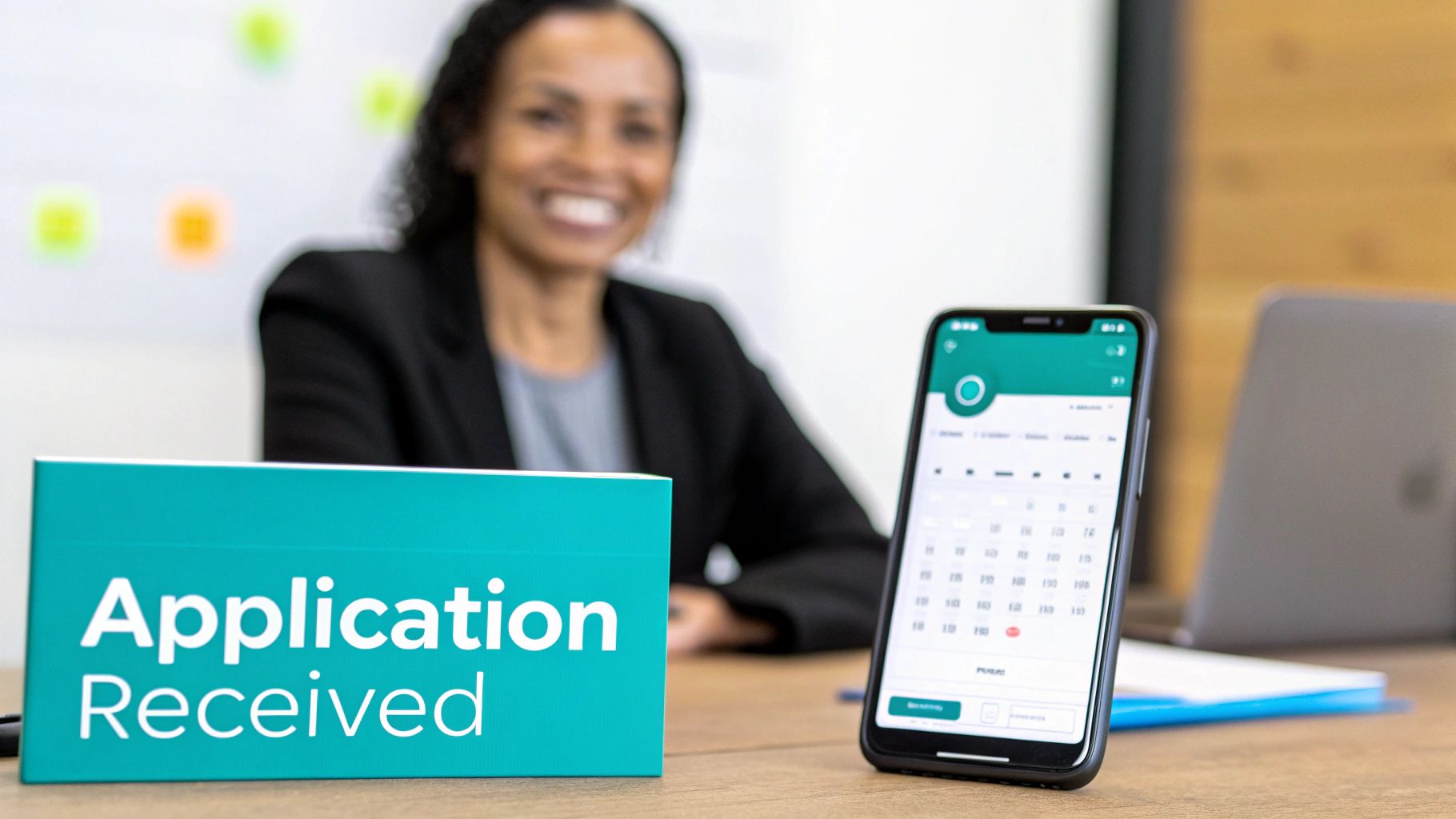
This practice is a cornerstone of modern candidate experience best practices because it builds trust and maintains engagement. When an application is submitted, an immediate, automated confirmation email reassures the candidate that their information was received. As they move through the pipeline, automated notifications from platforms like Greenhouse or Workable keep them informed of their status, whether they are moving forward, on hold, or no longer being considered.
How to Implement Automated Communication
Setting up an effective communication workflow is about more than just sending emails; it's about making candidates feel seen and valued.
- Personalize Automated Messages: Use tokens to include the candidate's name and the specific role they applied for. A message that reads "Hi Jane, thank you for your application for the Senior Marketing Manager role" is far more effective than a generic one.
- Set Clear Timeline Expectations: In your initial confirmation email, provide a realistic timeline for when candidates can expect to hear back. This manages expectations and reduces follow-up inquiries.
- Handle Rejections with Respect: Automate rejection messages to be prompt, but ensure they are respectful and empathetic. Whenever possible, encourage candidates to apply for future roles that may be a better fit.
Candidate Experience — 10 Best-Practices Comparison
| Approach | 🔄 Implementation Complexity | 💡 Resource Requirements | ⭐ Effectiveness / Key Advantages | 📊 Expected Outcomes | Ideal Use Cases |
|---|---|---|---|---|---|
| Mobile-First Conversational Interface Design | Medium–High — conversation flow & mobile UX | UX & front-end dev, mobile testing, basic NLU | High ⭐ — higher completion, better candidate satisfaction | 2.5x completion, ~40% faster mobile submissions, lower abandonment | High-volume recruiting, mobile-first candidates, onboarding |
| Intelligent Field Extraction and Contextual Questions | High — AI models, dynamic logic | NLP/ML infrastructure, training data, engineering | Very High ⭐ — personalized flows, improved data quality | Fewer irrelevant questions, more accurate data, reduced time-to-complete | Screening, role-based customization, quality data collection |
| Real-Time Visibility into Required vs. Optional Fields | Low–Medium — UI consistency required | Front-end implementation, design system updates | Medium–High ⭐ — reduces anxiety, sets clear expectations | Lower abandonment, improved data quality, fewer support queries | Forms with mixed required fields, mobile users, high drop-off risk |
| Instant Sharing and Zero-Friction Form Deployment | Low — link/QR generation and sharing features | Hosting/linking, integrations (email/SMS), QR tools | Medium ⭐ — rapid distribution, ease of use ⚡ | Faster time-to-candidate, rapid iteration, wider reach | Time-sensitive recruiting, events, quick surveys |
| Transparent Data Handling and Privacy-First Design | Medium–High — compliance, security architecture | Security engineering, legal/privacy resources, encryption | High ⭐ — builds trust and compliance confidence | Increased trust/completions, lower legal risk, better brand perception | Global organizations, sensitive data collection, regulated industries |
| Real-Time Analytics and Response Insights | Medium — tracking & dashboarding setup | Analytics tools, data engineers, analysts | High ⭐ — actionable insights for optimization | Identify bottlenecks, improve conversion, better forecasting | Growth/marketing, product onboarding, recruiting analytics |
| Customizable Templates and Rapid Configuration | Low–Medium — template library & no-code builder | Content/design for templates, UI for customization | Medium–High ⭐ — speeds creation, ensures consistency | Faster launches, reduced dev need, standardization | Startups, marketing campaigns, teams scaling form volume |
| Progressive Profiling and Data Enrichment | Medium–High — cross-touch data logic & sync | CRM integration, data governance, engineering | High ⭐ — richer profiles over time, less initial friction | Improved long-term candidate data, better personalization | Talent communities, nurture programs, multi-touch recruiting |
| Mobile-Optimized Submission Speed and Reduced Form Friction | Medium — optimize inputs & navigation | Front-end dev, device testing, UX research | High ⭐ — faster submissions, lower abandonment ⚡ | ~40% faster submissions, higher completion on mobile | Mobile audiences, competitive hiring markets, time-sensitive roles |
| Automated Candidate Follow-up and Response Communication | Medium — workflow design & messaging rules | Automation tools, ATS integration, content templates | High ⭐ — improves candidate experience, reduces manual load | Immediate confirmations, consistent updates, fewer inquiries | High-volume recruiting, scaling organizations, CX-focused hiring |
From Applicant to Advocate: The Future of Recruiting
The journey through the modern hiring funnel has fundamentally changed. We've moved beyond the era of static, impersonal application forms and entered a new landscape where every interaction matters. As we've explored, implementing world-class candidate experience best practices is not about a single initiative; it’s about architecting a seamless, respectful, and engaging journey from the very first click on a job posting to the final onboarding steps. This holistic approach transforms a purely transactional process into a powerful, relationship-building engine.
The core principle underpinning every best practice discussed, from mobile-first conversational design to transparent data handling, is a commitment to human-centricity. Candidates are no longer just data points in an applicant tracking system. They are potential colleagues, brand ambassadors, and future customers. A positive experience, even for those not hired, builds lasting goodwill and strengthens your employer brand in a competitive talent market. Conversely, a frustrating, opaque, or inefficient process can actively damage your reputation and deter top-tier talent from ever engaging with your company again.
Key Takeaways for Immediate Impact
To distill the comprehensive strategies covered in this article, focus on these three pivotal pillars for transformation:
- Friction is the Enemy: Every unnecessary field, every confusing question, and every moment of slow load time is a crack in your candidate experience. Your primary goal should be the relentless elimination of friction. This means optimizing for mobile, leveraging intelligent field extraction, and ensuring your application can be completed in minutes, not hours.
- Communication is Currency: In the absence of information, candidates will assume the worst. Proactive, transparent, and automated communication at every stage builds trust and demonstrates respect for their time and effort. From instant submission confirmations to clear timelines and constructive feedback, consistent communication is non-negotiable.
- Technology as an Enabler, Not a Barrier: The right technology should make your hiring process more human, not less. Tools that facilitate conversational interfaces, provide real-time analytics, and enable rapid deployment allow your recruiting team to focus on high-value interactions rather than administrative burdens. Platforms like Formbot exemplify this, enabling teams to build intelligent, user-friendly application flows without needing technical expertise.
Your Actionable Roadmap for 2026 and Beyond
Mastering these concepts is no longer a "nice-to-have" for forward-thinking companies; it is a critical business imperative. A superior candidate experience directly impacts key business metrics, including time-to-hire, quality of hire, offer acceptance rates, and long-term brand equity. By prioritizing the applicant’s journey, you create a powerful flywheel effect: great candidates have great experiences, they tell other great candidates, and your talent pipeline becomes a self-sustaining competitive advantage.
Start by auditing your current process. Go through your own application flow on a mobile device. Where are the friction points? How long does it take? What does the communication (or lack thereof) feel like? Use the candidate experience best practices outlined in this guide as your checklist for improvement. Begin with small, high-impact changes, measure the results, and iterate. The future of recruiting belongs to organizations that treat every applicant like their most valuable asset, because, in truth, they are.
Ready to transform your application process from a frustrating hurdle into your greatest recruiting asset? Discover how Formbot empowers you to build beautiful, conversational, and high-converting job application forms in seconds. Explore our templates and start building for free at Formbot to see why top teams trust us to deliver an unparalleled candidate experience.