Think of a customer experience survey as a direct conversation with the people who keep your business running. It's your chance to ask, "How are we really doing?" and get an honest answer. This isn't just about collecting data; it's a strategic tool for understanding the why behind your customers' actions, revealing what’s working, what's broken, and where your biggest opportunities are hiding.
Why Customer Experience Surveys Are Your Secret Weapon
In a crowded market, simply having a good product isn't enough. You have to understand your customer, and a customer experience (CX) survey is your company's real-time navigation system. It doesn’t just show you where you've been; it gives you the insights you need to chart a clear course for the future.
These surveys are much more than a report card. They're a proactive strategy for turning raw feedback into a reliable engine for improvement. By consistently asking for and acting on customer input, you can spot friction points and fix them long before they cause widespread frustration or, worse, lead customers to walk away.
Turning Feedback into a Growth Engine
When you stop guessing what customers want and start asking them, you can make data-driven decisions that hit the mark every time. This systematic approach to feedback delivers tangible benefits that go straight to your bottom line.
A solid survey program helps you:
- Reduce Customer Churn: You can spot unhappy customers, reach out to them directly, and resolve their issues—often turning a bad experience into a great one.
- Increase Customer Loyalty: When people feel heard and see their suggestions lead to actual change, their trust in your brand skyrockets.
- Inform Product Development: Surveys give you a direct line into what features customers love and what problems they still need you to solve, helping guide your innovation roadmap.
- Enhance Brand Reputation: Simply asking for feedback shows you care. Following up and closing the loop builds a powerful reputation as a company that puts its customers first.
A great customer experience is a proven growth driver. Companies that lead in CX grow revenue 80% faster than their competitors because great experiences turn first-time buyers into loyal advocates.
The Widening Gap in Customer Experience
Here’s the hard truth: customer expectations are rising much faster than most companies can keep up. This creates a dangerous gap between the experience brands think they're delivering and what customers actually feel. Recent research shows a worrying trend—customer experience quality is actually getting worse across many industries.
Forrester’s 2025 Global Customer Experience Index revealed a startling fact: in North America, the CX rankings for 25% of brands declined for a second straight year, while only 7% saw any improvement. Based on over 275,000 customer evaluations, the report makes it clear that even tiny dips in perceived quality cause a measurable drop in loyalty.
This shrinking margin for error means your customer experience survey is more critical than ever. Mastering your feedback program isn't just a good idea; it's one of the most powerful moves you can make to secure lasting success.
Decoding The Three Core CX Metrics
To get feedback that actually means something, you have to ask the right questions. And to do that, you need the right framework. This is where the three core customer experience (CX) metrics come into play. Don't think of them as complicated jargon—think of them as specialized lenses, each designed to bring a different part of the customer journey into sharp focus.
These metrics—Net Promoter Score (NPS), Customer Satisfaction (CSAT), and Customer Effort Score (CES)—are the bedrock of any solid CX survey program. Getting a handle on what each one measures and when to use it is the first real step toward turning raw feedback into a clear roadmap for improvement.
Net Promoter Score (NPS): The Loyalty Thermometer
Net Promoter Score, or NPS, is your go-to metric for gauging long-term customer loyalty and the overall health of your brand. It cuts right to the chase, answering one fundamental question: "Are our customers willing to stick their necks out and recommend us?" It does this with a single, surprisingly powerful question.
The classic NPS question is:
"On a scale of 0 to 10, how likely are you to recommend our company/product/service to a friend or colleague?"
Based on how they answer, customers fall into one of three buckets:
- Promoters (9-10): These are your die-hard fans. They're loyal, enthusiastic, and drive growth by telling everyone they know how great you are.
- Passives (7-8): These folks are content, but not thrilled. They got what they paid for, but they’re also easily swayed by a competitor's shiny new offer.
- Detractors (0-6): These are your unhappy customers. At best, they're silent; at worst, they’re actively sharing their bad experiences, which can seriously damage your reputation.
Your final NPS score is calculated by subtracting the percentage of Detractors from the percentage of Promoters. Any positive score is a good start, but a score over 50 is considered excellent. If you're looking to get started quickly, Formbot offers a ready-to-use NPS survey template that simplifies collecting this crucial data.
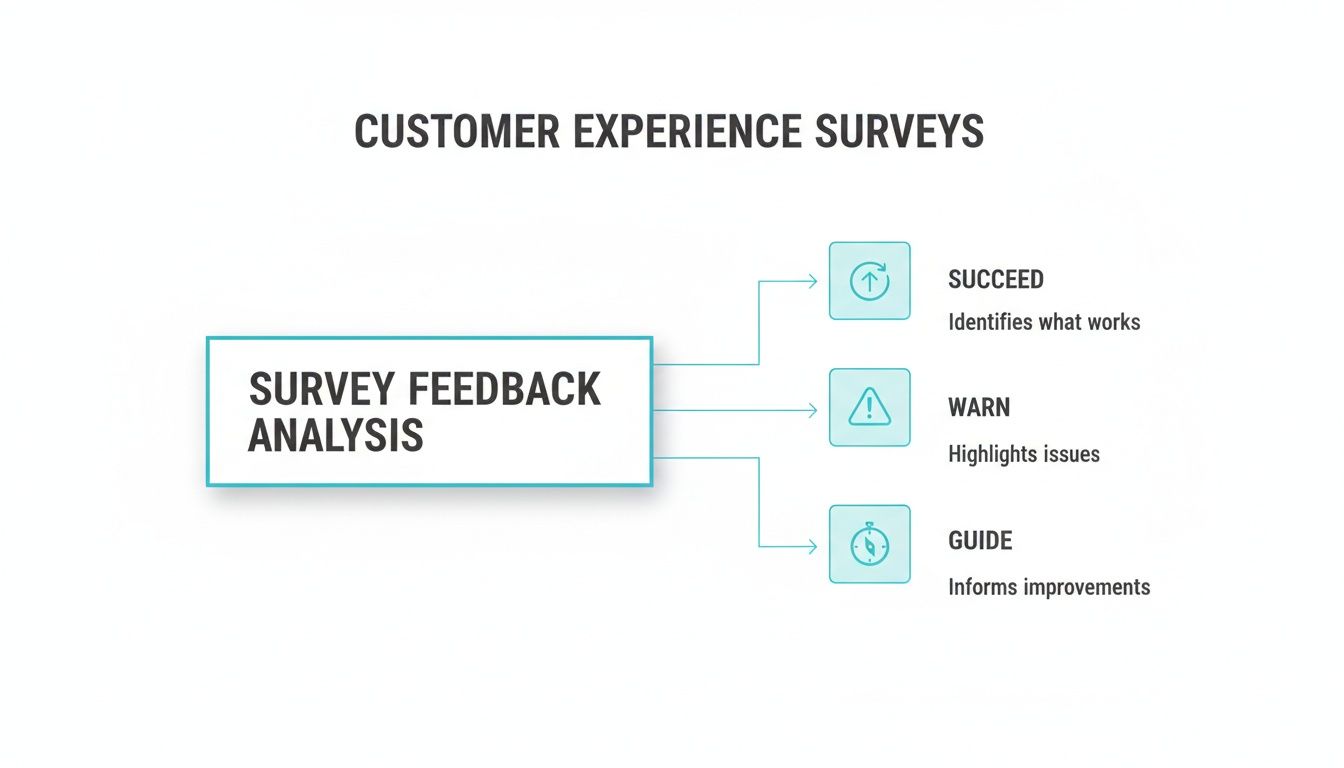
This diagram shows it perfectly: every piece of feedback is a signal. It tells you what's working so you can double down, warns you about problems before they escalate, and guides you on what to fix next.
Customer Satisfaction (CSAT): The Instant Snapshot
While NPS looks at the big picture of loyalty, Customer Satisfaction (CSAT) is all about the here and now. It’s an instant snapshot of how a customer feels about a specific, recent interaction—like a support call they just finished or a product they just bought.
The question is usually very direct:
"How satisfied were you with your recent experience?"
Responses are typically captured on a 5-point scale (e.g., from "Very Unsatisfied" to "Very Satisfied"). The final CSAT score is simply the percentage of customers who chose "Satisfied" or "Very Satisfied." It gives you immediate, tactical feedback you can act on right away.
Customer Effort Score (CES): The Friction Detector
Finally, we have the Customer Effort Score (CES). This metric measures one simple thing: how easy was it for the customer to get something done? The core idea here is that customers stick with companies that make their lives easier. Forcing them to jump through hoops is a surefire way to drive them away.
The CES question is framed like this:
"To what extent do you agree with the following statement: The company made it easy for me to handle my issue."
Customers usually answer on a 7-point scale from "Strongly Disagree" to "Strongly Agree." A lower average effort score means you're providing a smooth, frictionless experience, which is a powerful predictor of future loyalty.
Comparing Core CX Metrics: NPS vs. CSAT vs. CES
Deciding which metric to use can be tricky since each tells a different part of the story. Think of them as different tools in your toolbox—you wouldn't use a hammer to saw a board. This table breaks down the key differences to help you choose the right tool for the job.
| Metric | What It Measures | Typical Question | Best Use Case |
|---|---|---|---|
| NPS | Overall brand loyalty and likelihood to recommend | "How likely are you to recommend us to a friend?" (0-10 scale) | Measuring long-term customer relationships and predicting business growth. |
| CSAT | Short-term happiness with a specific interaction or touchpoint | "How satisfied were you with [specific interaction]?" (5-point scale) | Getting immediate feedback on specific events like a purchase or support ticket. |
| CES | The ease of a customer's experience | "The company made it easy for me to handle my issue." (Agree/Disagree scale) | Identifying and removing friction points in the customer journey, especially after service interactions. |
Ultimately, relying on just one of these metrics gives you an incomplete picture. CSAT might tell you a customer was happy with a support call, but CES reveals they had to call three times to solve the problem. Likewise, a high CSAT score doesn't always translate to loyalty. The most effective CX programs use a smart mix of all three to understand not just if customers are happy, but why, and what that means for the business down the road.
Designing Surveys That People Actually Want to Complete
Even the most brilliant customer experience survey questions are worthless if nobody answers them. This is where survey design becomes an art form—turning what could be a chore into a quick, even pleasant, interaction. Great design isn't about flashy graphics; it's about respecting your customer's time and mental energy.
The core principle is simple: keep it short and to the point. Every single question needs a purpose that ties directly back to your feedback goals. If a question won't help you make a concrete decision, it’s probably just noise. Cut it. It's also vital to use simple, human language. Ditch the corporate jargon and write like you're having a normal conversation.

Embrace the Conversational Approach
The real secret to modern survey design is focusing on the user experience, especially on mobile, where most people will see your survey. The days of endless scrolling forms are long gone. Today, the winning strategy is a conversational, one-question-at-a-time approach.
When you present questions individually, almost like a text message chat, it completely changes the dynamic. It gets rid of that intimidating wall of text that makes people close the tab before they even start. Instead, it feels like a fast, natural dialogue.
This chat-style flow works. Conversational surveys can boost completion rates because they feel less mentally taxing and allow for smarter, more relevant follow-up questions.
Set Clear Expectations From the Start
Even with an engaging design, you have to manage expectations. Nobody likes jumping into a task without knowing how long it will take. A few small details can make a world of difference in keeping people engaged.
Here’s what you need to include:
- Progress Bars: This simple visual cue shows people how far they’ve come and how much is left. It gives them a little sense of accomplishment and fights off the "is this almost over?" feeling that causes people to quit.
- Time Estimates: Be upfront in your survey invitation. A clear "This will only take 2 minutes" is so much more inviting than leaving them guessing.
- Clear Instructions: Make sure every question is impossible to misunderstand. For rating scales, spell out what each end means (e.g., "1 = Very Unhappy, 10 = Very Happy").
By being transparent, you show you respect your customer's time. That builds trust and encourages them to give you thoughtful, complete answers.
Craft an Invitation They Can’t Resist
Your first touchpoint—the survey invitation—sets the stage for everything that follows. A lazy invitation can sink your response rate before anyone even clicks the link. Your goal is to make your customers feel valued, not like you're giving them homework.
Your survey invitation is your first chance to prove you care. Frame the request not as a task for them, but as an opportunity for their voice to be heard and to help you build a better brand.
Here’s how to write an invitation that actually works:
- Personalize It: Use their name. If you can, reference the specific interaction, like, "Hi Sarah, we'd love your feedback on your recent order #12345."
- Explain the "Why": Quickly tell them how their feedback will be used. People are far more willing to help when they know their input will actually make a difference.
- Keep It Brief and Mobile-Friendly: The invitation email or text needs to be scannable. Get right to the point and make the call-to-action button or link big, bold, and obvious.
As you build out your surveys, you can borrow principles from creating effective customer feedback forms that drive valuable insights. Ultimately, the goal is to transform your customer experience survey from a simple data-collection tool into a positive brand interaction in its own right.
How to Write Questions That Uncover Real Insights
Great survey questions are the keys that unlock honest, actionable feedback. The quality of your entire customer experience program hinges on the quality of the questions you ask. If your questions are vague or biased, you'll end up with useless data. But when they're thoughtful and precise, they reveal genuine customer stories you can actually act on.
Think of it like this: a poorly written question is a blurry photo. You get a vague sense of what's there, but all the important details are lost in the haze. A great question, on the other hand, is a high-resolution image—sharp, clear, and full of information that shows you exactly what you need to see.

The Golden Rule: Avoid Leading Questions
The single most common mistake I see in survey design is the use of leading questions. These are questions phrased in a way that subtly nudges the respondent toward a particular answer, poisoning your data with bias before you even hit "send."
A leading question assumes how the customer feels or pushes them to agree with you. This creates a feedback loop built on your own assumptions, not their reality.
Here’s how to spot the difference:
- Leading Question: "How much did you enjoy our amazing new feature?" This question immediately frames the feature as "amazing," making it awkward for someone to disagree.
- Neutral Question: "How would you rate your experience with our new feature on a scale of 1 to 5?" This is a much better, unbiased alternative that gives them space for an honest response.
Always aim for neutral, objective language. Your goal is to uncover the truth, not to have your own opinions validated.
Crafting Questions for Different Goals
Not all feedback is created equal. The questions you ask should be tailored to the specific touchpoint you're trying to understand. A survey after a purchase requires a different set of questions than one following a support ticket.
Let's look at some practical, copy-and-paste examples for common goals.
To Evaluate a Recent Purchase:
- "How satisfied were you with the checkout process today?" (CSAT)
- "How easy or difficult was it to find what you were looking for on our website?" (CES)
- "Is there anything that could have made your purchasing experience better?" (Open-Ended)
To Measure Support Quality:
- "Based on your recent support interaction, how likely are you to recommend our company?" (NPS)
- "How satisfied were you with the resolution provided by our support agent?" (CSAT)
- "The support agent made it easy for me to handle my issue. (Agree/Disagree)" (CES)
For a deeper dive into crafting questions for real-time feedback, it's worth exploring how to create effective live chat survey questions.
The Power of Open-Ended Questions
While rating scales are great for crunching numbers, open-ended questions are where you find the real gold. They invite customers to tell you a story in their own words, revealing the crucial "why" behind their scores.
One powerful open-ended question can often provide more insight than ten multiple-choice questions. It uncovers the nuances, emotions, and specific details that rating scales simply can't capture.
These questions don't just collect data; they gather intelligence. Here are a few high-impact examples:
- "If you could change one thing about our product, what would it be?" This question cuts straight to your product's biggest weaknesses and opportunities for improvement.
- "What was the primary reason for your score?" Always follow up an NPS or CSAT question with this. It provides immediate context for their rating and is absolutely essential.
- "Is there anything else you'd like to share with us?" This simple, final question often yields the most surprising and valuable feedback. It gives customers a blank canvas to share what's truly on their mind.
Building a library of proven questions is a smart move. For more inspiration, check out our comprehensive list of survey questions examples to find the perfect prompts for any situation. By combining targeted, neutral rating scales with insightful open-ended prompts, you can build a customer experience survey that delivers clarity and drives meaningful change.
Build Your First Conversational Survey with Formbot
All this talk about great survey design is one thing, but actually building one? That used to be a headache. You’d need technical skills, a designer, or at least a lot of patience. Thankfully, that's not the case anymore. With a modern tool like Formbot, you can go from an idea to a live customer experience survey in just a few minutes.
Formbot was built to do the heavy lifting for you. It takes all those best practices—like conversational flow and mobile-first design—and bakes them right in. You can simply tell it what you need in plain English.
Think about it. You could type something like, "Create an NPS survey for new customers who just finished onboarding," and the AI instantly maps out a complete, logical survey. This saves a ton of time and makes sure you’re starting with a solid foundation.
From a Blank Page to a Live Survey in Minutes
This AI-first approach completely flattens the learning curve. You don't need to be a survey guru or a design whiz to launch something that looks professional and gets results.
Here’s a look at the Formbot interface. It’s clean, simple, and gets you started with either an AI prompt or a ready-made template.
What really makes Formbot click is its chat-like format. It automatically shows just one question at a time, which feels more like a quick text exchange than a boring old form. This is the conversational strategy we talked about earlier, and it’s proven to boost completion rates because it feels so much more natural.
A Full Toolkit for Effective Surveys
Beyond just building the survey, Formbot gives you everything you need to polish it up and get it in front of your customers.
Here are a few key features that make a real difference:
- Pre-built Templates: Not sure what to ask? No problem. You can skip the AI prompt and jump right into a huge library of templates for NPS, CSAT, CES, and just about any other scenario you can imagine.
- Easy Brand Customization: You can quickly add your logo, match your brand's colors, and pick the right fonts. This keeps the experience consistent and professional from start to finish.
- Simple Sharing via Link: Once you’re happy with your survey, you get a clean, simple link to share anywhere. No embedding code, no hosting hassles—just copy and paste.
The magic happens when you combine AI-powered creation with a friendly, conversational format. You end up with a customer experience survey that people actually want to complete, which means more responses and better feedback for you.
You can try it out for yourself without any commitment. Formbot has a free plan available on their pricing page that lets you build and launch your first survey immediately. It’s the perfect way to see how easy it is to get a professional feedback tool up and running in minutes, not days.
Turning Survey Feedback into Action
Collecting feedback is just the first step. Think of it like gathering ingredients for a recipe—you have all the raw materials, but the real magic happens when you start cooking. A folder full of survey responses is simply data; the real value comes from turning that data into loyalty, retention, and growth.
This all hinges on one critical process: closing the loop.
It’s about more than just passively collecting scores. It’s about actively responding to the feedback you get, proving to customers that their voice matters and their time was well spent. This single act can transform a simple survey into a powerful engine for building relationships and stopping churn in its tracks.

From Data Points to Actionable Themes
First things first: you need to look beyond individual scores to spot the bigger picture. As responses roll in, patterns will start to pop out from both your quantitative metrics (NPS, CSAT, CES) and the qualitative, open-ended comments. Don't get stuck just counting the numbers; start categorizing what people are saying.
Group the feedback into common themes. You'll likely see buckets like these form naturally:
- Product Issues: Are people repeatedly mentioning a specific bug, a confusing feature, or something they wish the product could do?
- Support Experience: What are the comments on wait times, agent knowledge, or how effectively problems were solved?
- Website Usability: Is there friction in the checkout process? Is site navigation a headache? How does it feel on mobile?
- Pricing and Value: Do customers feel they're getting a fair deal for what they pay?
This process is all about prioritization. One person complaining might be an outlier. But when ten people highlight the same issue, you've found a fire worth putting out. This methodical approach is a cornerstone of learning how to collect customer feedback that actually moves the needle.
The Power of Closing the Loop
Once you have your insights, it’s time to act. Closing the loop means reaching out directly to customers based on what they told you. The key is to segment your approach based on who you're talking to—your Detractors, Passives, or Promoters.
Closing the loop is the single most powerful way to show customers you're listening. It proves their feedback didn’t just vanish into a spreadsheet; it went to a human who cares.
For Detractors (your unhappy campers), the follow-up needs to be swift. A personal email or a quick phone call from a support manager can completely change their perception. The goal isn't just to say sorry, but to truly understand the root cause of their frustration and, whenever possible, fix it. This proactive outreach can often salvage a relationship on the brink of collapse and even turn a critic into a loyal fan.
For Promoters (your biggest fans), the follow-up is all about appreciation and activation. A simple "thank you" goes a surprisingly long way. This is also the perfect opportunity to ask them to channel that enthusiasm by leaving a review, referring a friend, or participating in a case study.
Using Insights to Drive Business Improvements
The final, and most crucial, step is to use these collective insights to make real, meaningful changes to your business. The themes you uncovered shouldn't live in a silo; they need to be shared across departments.
If customers keep getting tripped up by your onboarding process, that's a clear signal for the product team. If promoters consistently rave about your lightning-fast shipping, your marketing team has a powerful selling point to highlight.
By systematically listening and acting on feedback, you create a virtuous cycle of continuous improvement. You put the customer’s voice right where it belongs: at the very heart of your business strategy.
A Few Common Questions About CX Surveys
Even with a great plan, you'll inevitably run into some practical questions when you start sending out customer experience surveys. Nailing these details can be the difference between getting game-changing insights and just being another annoying email in your customer's inbox. Here are some quick, straightforward answers to the questions we hear most often.
How Often Should I Send a Customer Experience Survey?
This really boils down to what you're trying to measure. The best way to think about it is by splitting your surveys into two camps: transactional and relational.
Transactional surveys, like a CSAT or CES score, are all about a specific, recent interaction. You should send these out right away—think moments after a customer finalizes a purchase or a support agent closes their ticket. The memory is fresh, and the feedback will be much more specific and actionable.
Relational surveys, like the NPS, are designed to gauge the overall health of your customer relationship. These are best sent on a regular schedule, maybe once a quarter or every six months. You're looking for a consistent rhythm that gives you a pulse on customer sentiment without overwhelming them with requests.
What Is a Good Response Rate for a CX Survey?
Honestly, there's no single magic number here. A "good" response rate can swing wildly depending on your industry, the channel you use (email vs. in-app pop-up), and just how loyal your customer base is.
As a very general benchmark, email surveys often see response rates somewhere between 5% and 30%. But instead of getting hung up on a universal average, it's far more valuable to focus on improving your own rate over time. Small, steady gains are a much better sign of a healthy program than trying to hit some arbitrary industry figure.
The real goal isn't just hitting a certain percentage. It's making sure the responses you do get are a true reflection of your customer base. High-quality, thoughtful feedback from an engaged group is always better than a mountain of half-hearted clicks.
How Can I Get More People to Respond?
Getting more people to participate is all about making the survey experience as painless and inviting as you possibly can. A few small tweaks can make a surprisingly big difference in your completion rates.
Here are a few tactics that consistently work:
- Keep It Short & Mobile-First: Everyone is busy. A survey that’s quick and works flawlessly on a phone respects their time and will always get more responses.
- Personalize the Ask: A little personalization goes a long way. An email that says, "Hi Alex, we'd love your feedback on order #54321," feels like a genuine request, not a generic marketing blast.
- Set Clear Expectations: Let people know what they're getting into. Simply stating, "This will only take 2 minutes," and explaining how you'll use their feedback shows you value their time and input.
- Offer a Small Thank You: A relevant incentive, like a discount on their next purchase or an entry into a gift card drawing, can be a great nudge. It shows you appreciate them taking the time.
Ready to build surveys that people actually want to answer? With Formbot, you can use AI to generate a conversational customer experience survey in seconds. Its one-question-at-a-time format is designed to boost completion rates and get you the insights you need. Start building for free at tryformbot.com.