You get one shot at a first impression. For a survey, that first impression is the introduction, and it’s the single most important factor in deciding whether someone hits "start" or instantly closes the tab.
This isn't just about being polite. Your intro is a strategic tool that sets the stage, builds trust, and has a direct, measurable impact on both your response rates and the quality of the data you get back.
Why Your Survey Introduction Matters Most

Think of your survey's opening lines as a digital handshake. A good one isn’t a formality; it’s the foundation of a successful data-gathering effort. It has to immediately convince people that their time and opinions are genuinely valued. That's the only way to earn their attention.
When you nail the introduction, you prime respondents to give more thoughtful, honest answers. You’re turning a sterile form into a genuine conversation, which is your best defense against survey fatigue before they’ve even answered a single question.
The Strategic Impact of a Strong Start
Let's be blunt: the primary goal is to stop people from bailing. A vague, uninviting, or confusing welcome screen is the number one killer of response rates. By clearly explaining the "why" behind the survey and what's in it for them, you build the trust needed to get real feedback.
This simple, human-focused approach is what separates an enthusiastic participant from just another lost data point.
A survey's success is often decided in the first five seconds. Your introduction must quickly answer the participant's core question: "Why should I care?"
Getting that initial engagement also means making your survey easy to find and start. Making access dead-simple can dramatically improve participation. For example, learning how to create a QR code for a Google Form to boost responses instantly is a fantastic way to reach mobile users effortlessly.
Ultimately, a killer introduction to a survey has to accomplish three things:
- Build Instant Trust: Show you respect their time and privacy right away.
- Set Clear Expectations: Let them know why you're asking and how long it will take.
- Boost Completion Rates: A warm, clear start gives people the motivation to finish.
The 5 Essential Elements of a Great Survey Intro

A fantastic survey introduction isn't magic; it’s a carefully assembled machine. It has five core parts that work together to turn a simple "hello" into a powerful response-driving tool. Think of them as the essential ingredients in a recipe.
If you leave one out, the whole thing can fall flat, and your response rates will suffer. But when you get them all right, you create a transparent and welcoming experience that pulls people in and delivers much better data.
1. Clearly State Your Purpose
Right off the bat, you have to answer the question that's already in your reader's mind: "Why should I care?" A vague request is easy to ignore because it feels unimportant. You need to be direct and tell them exactly what you're trying to accomplish with their feedback.
For example, don't just say, "Please take our survey." Instead, try something like, "Help us improve our checkout experience by sharing what you think." This gives them context, shows their opinion has a real purpose, and gets them invested from the very first sentence.
2. Give an Honest Time Estimate
Nobody likes being tricked into a commitment. Respect your audience's time by giving them a realistic estimate of how long the survey will take. There's nothing worse than starting a "quick 2-minute survey" that ends up eating ten minutes of your day.
Pro Tip: Always round up. If you test the survey and it takes 4 minutes, just tell them it takes 5. This little buffer builds trust. When they finish ahead of schedule, they feel good about it. It’s a simple psychological win based on under-promising and over-delivering.
Being upfront allows people to decide if they have the time, which dramatically cuts down on how many people bail out midway through.
3. Reassure Them About Data Privacy
In 2026, people are more protective of their data than ever. Your introduction must address how you'll handle their information. A few simple words can put most of their worries to rest.
It’s a good idea to include phrases like:
- "Your responses are completely confidential."
- "All feedback is anonymous and will only be used to make our product better."
- "We will never share your personal information with anyone."
This simple act of reassurance builds the trust needed to get honest, unfiltered feedback.
4. Highlight Any Incentives
Are you offering something in return for their time? Let them know right away. Whether it’s a discount, a gift card, or a chance to win something, mentioning the incentive in your intro gives people an immediate, concrete reason to participate.
This isn’t about bribing people; it's about showing you value their time. For longer or more complex surveys, a well-placed incentive can be the single biggest factor in boosting your response rates.
5. End with a Clear Call to Action
After you've set the stage, you need to guide them to the first question. Every great intro wraps up with a direct, impossible-to-miss call to action (CTA). Don't make people guess what to do or search for the "next" button.
Use strong, action-oriented text like "Start the Survey," "Share Your Feedback," or "Get Started Now." The CTA should feel like the obvious next step, moving them smoothly from the introduction right into the survey itself.
Using Context to Frame Your Survey Questions
A great survey introduction does more than just state your intentions—it anchors your questions in the respondent's world. When you ground your survey in a relevant, timely context, asking for feedback feels less like a random interruption and more like a conversation they actually want to be a part of.
Think about it: when you show you're aware of the trends or challenges impacting your audience, you're proving you’ve done your homework. This simple step builds instant credibility. It signals that you're not just trying to tick a box; you're looking for thoughtful, nuanced answers. This approach almost always leads to higher engagement and far better data quality. For projects like comprehensive UX audits for Shopify stores, framing your questions with the right context is the secret to uncovering truly valuable insights.
Connecting to the Bigger Picture
One of the best ways to add context is to reference external data points your audience already knows and cares about. This could be anything from industry benchmarks to well-known economic forecasts. By framing your questions against these broader realities, you immediately make them feel more urgent and significant.
For instance, a survey about business planning for the coming year feels much more critical when you tie it to current economic headwinds. Mentioning a specific forecast shows you understand the real-world pressures your respondents are under, making them far more willing to share their own plans and concerns.
The United Nations’ World Economic Situation and Prospects 2026 report projects global economic output growth of 2.7% in 2026. It also notes that high prices continue to squeeze household incomes. Referencing these figures is a powerful way to frame questions about budget pressures or investment confidence. You can dig into these trends in the full UN report.
This technique subtly lets participants know their feedback isn't just for you—it will contribute to a wider understanding of a challenge you're all facing together.
Putting Context into Practice
So, how do you actually do this? It's pretty straightforward. Before you even write your introduction to a survey, take a moment to think about the external factors shaping your audience's reality.
- For B2B Surveys: Talk about industry growth projections, nagging supply chain issues, or new technology adoption rates. A question about software budgets suddenly becomes more relevant when you mention a recent report on digital transformation spending.
- For Employee Surveys: Reference company milestones, recent organizational changes, or broader workforce trends. Asking about professional development feels more meaningful when you link it directly to the company's new strategic goals for 2026.
- For Customer Feedback: Connect your questions to recent product updates, seasonal buying patterns, or a new feature you just launched. This shows customers you want specific, actionable feedback tied directly to their latest experience.
By providing this framing, you elevate your survey from a simple questionnaire to a meaningful dialogue. To see how this works with specific questions, check out our guide on survey questions and examples.
Survey Introduction Examples for Any Scenario

It's one thing to know the theory behind a good survey intro, but seeing it work in the wild is where the real learning happens. The best introductions aren't one-size-fits-all; they shift their tone, length, and focus based on who you're talking to and what you're trying to accomplish. A quick customer feedback poll needs a completely different feel than a deep-dive employee engagement survey.
To make this crystal clear, let's walk through a few real-world examples. For each scenario, I’ll show you a traditional, static text version and a more modern, conversational one. You'll see how a chat-based approach can make the whole interaction feel more personal and human, which often does wonders for completion rates.
Customer Satisfaction (CSAT) Survey
With this kind of survey, speed is everything. Your customers are busy, so the intro has to be short, punchy, and get right to the point. The key is to immediately show them how their feedback makes their own experience better.
Traditional Version: "Help us improve! Your feedback on your recent purchase is important to us. This survey will only take about 2 minutes to complete. All responses are confidential. Click 'Start' to begin."
Conversational Version: "Hey there! Got a minute to help us make your experience even better? We’d love to hear what you thought of your recent purchase. It’s just 3 quick questions. Ready?"
Employee Engagement Survey
When you're surveying your own team, you can afford to be a bit more detailed. The main goal here is to build trust and prove that leadership is actually listening. Your intro must guarantee anonymity to get the honest, constructive feedback you need.
Anonymity is the bedrock of a successful employee engagement survey. Your introduction must explicitly state that individual responses are confidential and will be aggregated to protect privacy. This single promise can be the difference between getting surface-level answers and uncovering deep organizational insights.
Traditional Version: "Your feedback is essential to making [Company Name] a better place to work. This confidential survey will take approximately 10 minutes to complete. Your honest responses will help us understand what we're doing well and where we can improve. All data is anonymous and will be reported in aggregate only. Please submit by [Date]."
Conversational Version: "Hi [Employee Name], we’re working on making [Company Name] an even better place to work, and your voice is crucial. Could you share your honest thoughts with us? It should take about 10 minutes, and I promise your responses are completely anonymous. Let’s get started?"
New Product Research Survey
Asking for thoughts on a new idea is your chance to create some buzz and make people feel like they're part of an exclusive club. Your introduction should play up the "insider" angle and emphasize how much their opinion will shape the final product.
Traditional Version: "Help shape the future of [Product Category]! We are developing a new product and would value your expert opinion. This research survey will take about 5 minutes. Your insights will directly influence our design and features. All information you provide will be kept confidential."
Conversational Version: "You're one of the first people to see this! We're working on a new [Product] and would love your expert opinion. Want a quick sneak peek? It'll only take about 5 minutes to share your thoughts and help us build something amazing."
Optimizing Your Intro for a Mobile-First World
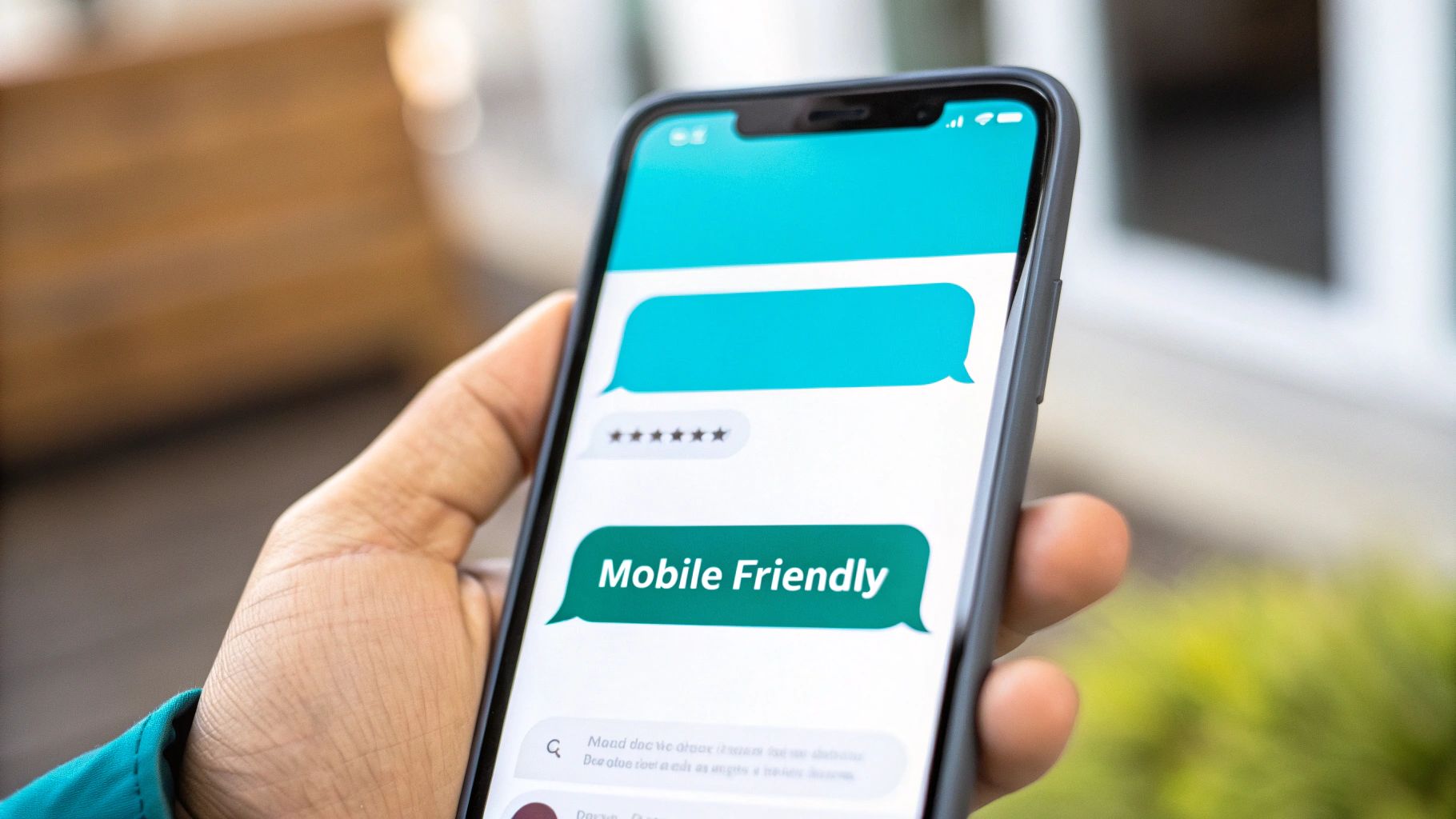
Let's face it: we live on our smartphones. It's where we connect, shop, and, you guessed it, answer surveys. Asking your audience in 2026 to patiently pinch and zoom through a clunky desktop form on their phone is a surefire way to get them to close the tab.
This means a mobile-first approach to your introduction to a survey isn't just a nice feature—it's essential for survival.
The game is completely different on a smaller screen. Long, dense paragraphs that look fine on a desktop are instant deal-breakers on a phone. They create immediate friction and are a major reason people abandon a survey before answering a single question.
Your goal is to make the entire experience feel as effortless as sending a text message. Success here comes down to two things: being brief and creating a clear visual path that guides the eye.
Designing for Thumbs
Think about how you actually use your phone. You’re scrolling and tapping with your thumb, usually while doing something else. Your survey intro needs to be built for this kind of quick, thumb-driven interaction, not for deep reading.
Here are a few ground rules:
- Keep It Short and Sweet: Break your welcome message into tiny, digestible chunks. A single paragraph should rarely be more than one or two sentences.
- Use Visual Cues: Don't be afraid to use emojis. A simple wave emoji 👋 or a thumbs-up 👍 can instantly make your intro feel more personal and less like a sterile form.
- Make the CTA Obvious: The "Start Survey" button needs to be big, bold, and impossible to miss. Nobody should have to hunt for it.
A great mobile introduction isn't just a shrunken-down version of your desktop design. It's a fundamental rethinking of the experience, built from the ground up for speed, clarity, and ease of use. If you want to go deeper, exploring these form design best practices will help you nail the entire user journey.
This is exactly why chat-based platforms are so effective. They are designed for mobile conversation from day one, transforming a static, boring form into a natural back-and-forth exchange.
Just look at how a conversational survey intro from Formbot appears on a phone.
The chat bubble format feels instantly familiar and far less intimidating than a traditional form wall. For anyone on a mobile device, this simple change dramatically lowers the barrier to getting started.
Measuring the Success of Your Survey Introduction
You don't just write a great survey introduction; you build one with data. Instead of crossing your fingers and hoping it works, you can actually measure its performance and make smart, targeted improvements. This is how you turn a decent intro into a truly high-performing one.
The first step is simply knowing what to look for. Two key metrics will tell you almost everything you need to know about how well your intro is doing its job. Think of them as your guideposts for optimization.
Key Metrics to Monitor
The most telling sign of a weak intro is the first-page drop-off rate. This number shows you exactly what percentage of people land on your survey, read the intro, and then leave without ever answering the first question. A high drop-off rate is a flashing red light telling you the welcome message isn't working.
You should also keep an eye on the overall completion rate. While this metric reflects the entire survey experience, a poor start can sour the whole thing. A confusing or uninspiring intro often kills a respondent's motivation early on, making them more likely to bail out on later questions.
A strong introduction sets a positive tone for the entire survey. By reducing initial friction and building trust, you not only lower first-page drop-offs but also give respondents the momentum needed to reach the final question.
A/B Testing Your Introduction
Once you have your metrics, you can start experimenting. This is where A/B testing comes in. The idea is simple: you create two slightly different versions of your introduction (let's call them Version A and Version B) and show them to separate groups of people to see which one performs better.
You can test just about any part of your introduction to a survey:
- Tone: Try a friendly, casual voice against a more formal, direct one. Which one resonates?
- Incentive Placement: Does mentioning the reward right at the beginning give people a bigger push to start?
- Length: Is a short, punchy intro more effective than one with a bit more detail and context?
- Call to Action: Does a button that says "Get Started" work better than one that says "Share Your Feedback"?
By running these simple tests and watching the numbers, you can systematically improve your approach. This data-driven process takes the guesswork out of it, ensuring your introductions are always optimized for the best possible engagement.
For more powerful strategies, check out these 10 proven tactics for increasing survey response rates.
Got Questions? We've Got Answers.
Still have a few things on your mind about writing the perfect survey intro? Let's tackle some of the most common questions we hear.
How Long Should My Survey Introduction Be?
There's no single magic number, but think short and sweet. You should be aiming for somewhere between 30 and 60 words, tops. The goal is to hit the key points—what it's for, how long it takes, and that their data is safe—without making them read a novel before they've even answered a single question.
On mobile, it's even more important to be concise. Breaking the intro into a few quick, chat-style messages often works wonders.
Is an Incentive Always a Good Idea?
Not always. Incentives really shine when you're asking for a lot of someone's time or trying to connect with an audience that doesn't know you well. Think of it as a little nudge for a big ask.
But for your loyal customers or engaged team members giving quick feedback, a sincere intro that shows you genuinely value their opinion is often all you need. Be careful not to overuse rewards, as you can sometimes attract people who just want the prize, which can muddy the quality of your data.
Your respondent's time is valuable. While an incentive directly compensates them, a clear and respectful introduction that explains why their specific feedback matters can be just as powerful in motivating a response.
Can a Great Introduction Make Up for a Bad Survey?
Afraid not. A brilliant introduction is your handshake—it gets people through the door. But it can't salvage a survey that's confusing, biased, or drags on forever.
If people get frustrated with the questions, they'll leave, no matter how great your opening was. Your intro and your survey need to work together, creating a smooth and respectful experience from the first word to the last click.
Ready to stop losing respondents before they even start? With Formbot, you can build conversational surveys that feel more like a quick chat than a boring form. See for yourself how a better introduction can transform your response rates.
Explore our plans and get started for free.