An automated job application system is a smart software platform that takes over the most repetitive parts of the hiring cycle. Think of it as a digital assistant for your recruitment team, one that works around the clock to handle the flood of applications and initial screening. This frees up your human recruiters to do what they do best: connect with top candidates, conduct meaningful interviews, and make those crucial hiring decisions.
How Automated Hiring Actually Works
Let's get real for a moment. You post a great job opening and, within a week, 500 applications land in your inbox. Sifting through every single resume and cover letter manually is a recipe for burnout. It’s also how incredible candidates slip through the cracks. This is precisely where an automated system steps in.
Instead of just dumping everything into an email folder, the system acts as an intelligent filter. It uses technology to instantly sort, categorize, and even rank applicants based on the specific qualifications you set. It's not about taking the human element out of hiring—it's about giving your team the speed and data they need to make better decisions. The system does the initial heavy lifting, making sure every single applicant gets a fair look against the job's core requirements.
Moving Past the Piles of Paperwork
For too long, hiring has been bogged down by administrative headaches. Recruiters burn hours on manual data entry, and candidates are often left wondering if their application ever saw the light of day. This old-school approach isn't just slow; it's wide open to human error and unconscious bias.
An automated system creates a consistent, fair, and efficient foundation for your entire recruitment strategy. It ensures that every candidate is evaluated against the same objective criteria, leveling the playing field and reducing the chances of a great applicant being overlooked by mistake.
This shift isn't just a "nice-to-have." In a world where the best talent gets snapped up quickly, a clunky, slow application process can seriously damage your brand and send top candidates running to your competitors.
To really see the difference, let's compare the old way with the new.
Table: Traditional vs Automated Application Processes
| Process Step | Traditional Manual Process | Automated System Process |
|---|---|---|
| Application Submission | Candidates email resumes to a general inbox or fill out a basic web form. | Candidates interact with a conversational form or chatbot that collects structured data. |
| Initial Review | A recruiter manually reads every resume and cover letter to check for basic qualifications. | The system instantly parses resumes and screens candidates against predefined job criteria. |
| Candidate Communication | Acknowledgment emails are sent manually (if at all). Status updates are often delayed. | Instant, automated confirmation emails are sent. Candidates receive timely status updates. |
| Shortlisting | Recruiters create shortlists based on manual notes and spreadsheets. Prone to bias. | The system generates a ranked shortlist of the most qualified candidates based on objective data. |
| Data Management | Candidate information is scattered across emails, folders, and spreadsheets. | All candidate data is centralized in a single, searchable database. |
As you can see, the automated process introduces a level of efficiency and consistency that's simply impossible to achieve manually.
The Core Job of an Automated System
At its heart, an automated job application system is designed to bring order to the chaos of hiring. It introduces a clear, structured workflow that makes life easier for both your hiring team and your applicants.
Here's what it typically handles:
- Centralized Application Collection: It pulls in all applications—from your careers page, job boards, social media—and puts them into one organized dashboard.
- Automated Candidate Screening: It uses your rules and keywords to quickly flag applicants who meet the must-have qualifications for a role.
- Consistent Communication: It sends instant "we got your application" emails and can even provide automated updates as candidates move through the process.
- Data-Driven Insights: It gives you analytics on your hiring efforts, showing you which sources deliver the best candidates and where you might have bottlenecks.
The technology behind this has evolved significantly, and it's worth exploring the different AI job application tools that are changing the game. This isn't just a minor upgrade; it's a fundamental shift that turns recruiting from a reactive administrative chore into a proactive, strategic advantage for your business.
The Real ROI Of Automation In Hiring
When you're thinking about new technology, it all boils down to one simple question: what’s the actual return? For an automated job application system, the answer goes way beyond just making things easier. The true value comes from hard financial savings, huge boosts in efficiency, and a real strategic edge in the race for top talent in 2026.
The most obvious win is for your budget. A huge benefit—and a key metric for ROI—is how these systems slash the recruitment cost per hire. By taking over the initial screening and tedious admin tasks that eat up countless hours, you bring down the operational costs of filling every single role.
And we're not talking about minor tweaks here; the financial impact is massive.
Driving Down Costs And Accelerating Timelines
Automating your application process directly tackles two of the most painful metrics in recruiting: cost-per-hire and time-to-fill. When your team isn't manually sifting through every resume or chasing down schedules for interviews, they can put their energy where it really counts—on the high-value activities that need a human touch.
The numbers really speak for themselves. Companies using AI-powered recruiting tools are seeing a 30% reduction in their cost-per-hire and a 40-50% improvement in time-to-hire. On top of that, teams with AI-augmented applicant tracking systems report a 55% faster time to hire, 53% better candidate quality, and 49% higher recruiter productivity. Statistics like these make it pretty clear that an automated system delivers a straightforward, measurable return.
By automating the top of the hiring funnel, you not only reduce direct costs but also get qualified candidates in front of hiring managers faster. This speed is a critical competitive advantage when top talent is often considering multiple offers.
This infographic paints a clear picture of the core benefits driving this incredible return on investment.
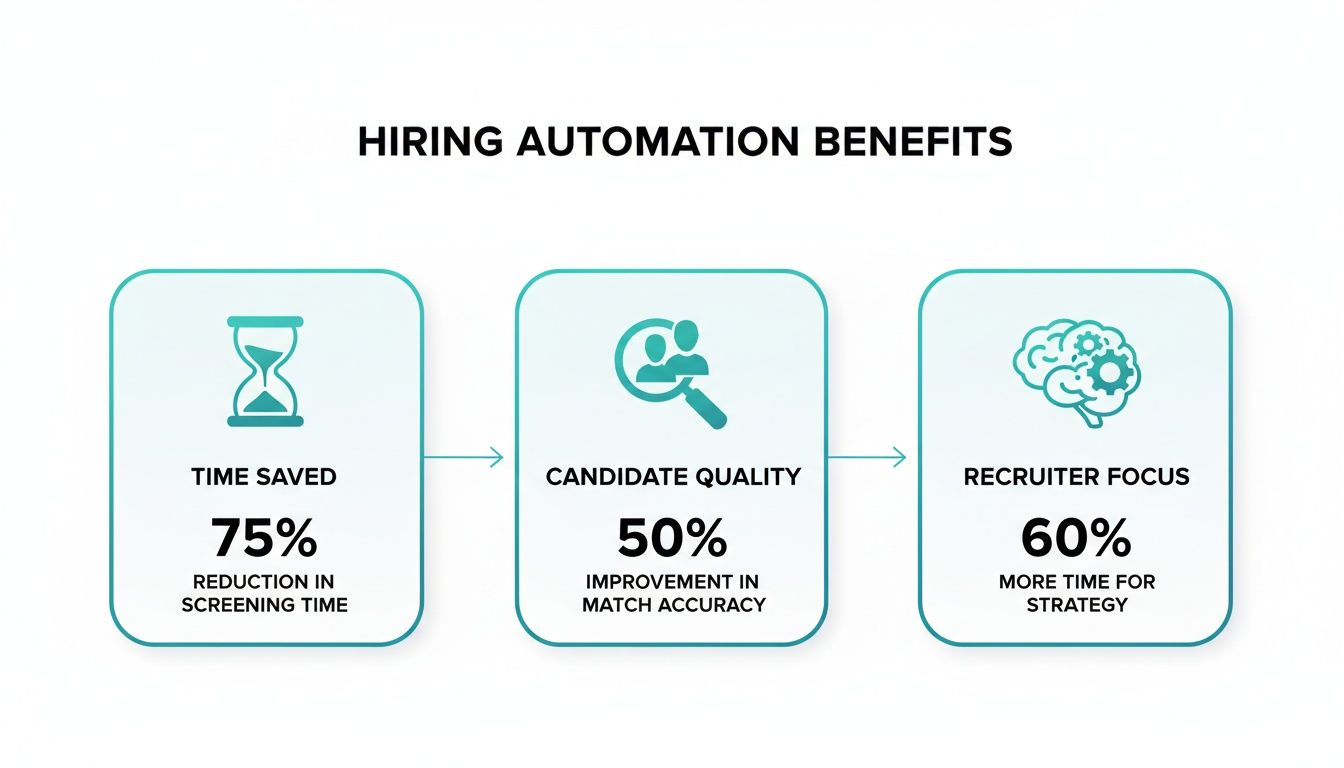
As you can see, automation delivers big wins across the board, from time savings and candidate quality to giving recruiters their focus back.
Uncovering The Powerful Secondary Returns
While the money saved is a great headline, the secondary benefits of automation build long-term value that’s just as crucial. These returns touch everything from the quality of your workforce to the perception of your employer brand.
For starters, an automated system ensures every single applicant is screened against the same objective, job-related criteria. This data-driven approach helps minimize unconscious bias and often uncovers fantastic candidates who might have been missed in a quick manual scan. The result is a consistent uptick in the quality of hire.
Automation also has a profound effect on the candidate experience. Let's be honest, a slow, clunky application process is a major turn-off for the best people out there.
Here are a few of the key secondary benefits:
- Elevated Candidate Experience: Instant confirmations, timely updates, and easy-to-use forms show candidates you value their time. That goes a long way in strengthening your employer brand.
- Increased Recruiter Productivity: With the administrative weight off their shoulders, recruiters can focus on strategic sourcing, building talent pipelines, and serving as true talent advisors to the business.
- Improved New Hire Retention: A smooth and professional hiring process sets a positive tone from the very first interaction. When the experience feels organized and respectful from day one, new hires are more likely to stick around.
At the end of the day, a great application process is a non-negotiable part of the candidate's journey. You can dig deeper into creating that positive first impression by exploring these candidate experience best practices. A well-designed automated system isn't just about efficiency; it's about building a smarter, more strategic, and more human talent function.
Core Components Of A Modern Hiring System
To really get what an automated job application system can do, you have to look under the hood. It’s not just one piece of tech; it's a suite of smart tools working in concert to create a seamless hiring workflow. Think of it like a high-performance engine—every part has a specific, vital role to play.
These components take what can be a chaotic, paper-shuffling mess and turn it into a streamlined, data-driven operation. They cover the entire journey, from a candidate's first click on your careers page to the final handoff to your HR team. Let's break down the essential pieces that make these systems tick.
AI-Powered Resume Parsing And Scoring
The first massive hurdle in high-volume recruiting is simply managing the flood of resumes. This is where resume parsing comes in. It’s an automated process that uses AI to instantly read and make sense of resumes, regardless of their layout or format.
The system intelligently pulls out key information and organizes it into a neat, structured profile for every single applicant. Your team can finally stop the soul-crushing manual data entry. The tech extracts the critical details you actually need:
- Contact Information: Names, emails, and phone numbers are captured with precision.
- Work Experience: Job titles, company names, and employment dates are identified and sorted chronologically.
- Education and Skills: Degrees, certifications, and specific technical or soft skills are cataloged and made searchable.
But today's systems do more than just extract data—they score candidates. By comparing the information it just parsed against the specific requirements in your job description, the system can automatically rank applicants. This immediately floats the most qualified people straight to the top of your list.
Seamless Applicant Tracking System Integration
An automated application system can't be a lone wolf. Its real power is unlocked when it connects directly with your existing Applicant Tracking System (ATS), which is the heart of all your hiring activities. This integration creates a single, unified command center.
When a candidate applies through a modern front-end, all their parsed data, scores, and documents should flow directly into the correct record in your ATS. This simple connection eliminates the need to manually copy and paste information between systems, a process that’s a breeding ground for mistakes and delays.
A seamless ATS integration ensures that all candidate data is centralized and up-to-date, providing your entire hiring team with a single source of truth. This is fundamental for maintaining an organized and efficient hiring pipeline from start to finish.
This deep connection lets recruiters manage the entire candidate journey—from the initial application to interview scheduling and the final offer—all within the familiar environment of their primary ATS.
Dynamic And Conversational Application Forms
The application form itself might be the most important component because it's the very first real interaction a candidate has with your hiring process. We've all seen them: traditional, long, clunky forms that are notorious for making great people give up and close the tab. You're losing top talent before you even know they're there.
A modern automated job application system throws those out and replaces them with dynamic, conversational interfaces. Imagine an application that feels less like filling out tax forms and more like a quick chat with a helpful guide.
This approach has some major upsides:
- Improved Completion Rates: A chat-based UI is far more engaging and way less intimidating, especially on a phone.
- Richer Data Capture: A conversational form can ask smart follow-up questions based on a candidate's previous answers. This allows you to gather more detailed and relevant information than a static form ever could.
- Enhanced Candidate Experience: This modern, respectful approach shows candidates you value their time. It makes your company look forward-thinking and creates a positive first impression that sets you apart from the competition.
By blending intelligent resume parsing, deep ATS integration, and an engaging conversational front-end, a modern system turns hiring from a series of disjointed manual tasks into a cohesive, efficient, and candidate-friendly machine.
How A Conversational Form Changes The Game
Think about your current application form. Is it a warm welcome or a high hurdle? For most companies, it's the latter. We've all been there—staring at a long, intimidating form that feels more like a tax audit than a job application. This is the exact moment where great candidates decide it’s just not worth the effort and click away.
An automated job application system flips this entire experience on its head. It swaps out those clunky, multi-page forms for a simple, engaging conversational interface. This isn't just a minor tweak; it's a fundamental shift that transforms a chore into a positive first impression. It immediately tells applicants that your company is modern, efficient, and values their time.
Turning Applications Into Conversations
Instead of bombarding a candidate with a wall of empty boxes, a conversational form guides them through the process one simple question at a time. It feels like a friendly chat. This approach is far less intimidating and way more intuitive, which is crucial when you consider that 70% of candidates now apply for jobs on their phones.
Tools like Formbot are built to make this transition seamless. You can create a chat-based application form without touching a single line of code. Just describe what you need in plain English, and its AI builds a conversational experience that feels completely natural, keeping candidates engaged and moving forward.
Here’s a look at how that interactive, chat-like experience appears to a candidate.

This user-friendly front end is the welcome mat for all the powerful automation happening behind the scenes, ensuring candidate data flows smoothly right where you need it.
By making the application process feel as easy as a text message exchange, you can boost completion rates dramatically. That means more qualified people actually finish the application instead of dropping off.
This isn't just about getting more applicants; it's about building a positive brand reputation from the very first click.
The Power Of Smart, Adaptive Forms
A modern conversational form doesn't just ask questions—it listens and adapts in real-time. The AI behind a tool like Formbot can understand natural language, letting candidates provide information in a way that feels comfortable to them. The system then intelligently pulls out the key details it needs.
For instance, if the form asks for an available start date and the candidate types, "I can start two weeks from next Monday," the system gets it. It understands the context and correctly populates the date field, only asking for clarification if something is genuinely missing or unclear. This makes the whole process feel personal and incredibly efficient.
This adaptive technology allows you to:
- Ask Relevant Follow-Up Questions: If a candidate mentions they have project management experience, the form can dynamically ask about specific certifications, like PMP. It creates a path tailored to their skills.
- Reduce Form Fatigue: Showing one question at a time and intelligently skipping things that don't apply makes the application feel shorter and less overwhelming.
- Capture Richer Data: The conversational flow often encourages people to provide more thoughtful, detailed answers than they would in a standard, sterile text box.
Putting these ideas into practice creates a system that isn't just faster but also smarter. To really nail this, it helps to understand what makes any digital interaction effective. For a deeper dive, check out these essential form design best practices, which apply just as much to conversational interfaces as they do to traditional ones.
Ultimately, a well-designed conversational form is the perfect gateway to your automated hiring system, making sure you attract—and keep—the best talent from that very first interaction.
Your Implementation Checklist For A Smooth Rollout

Successfully launching an automated job application system takes more than just picking a cool new tool; it requires a thoughtful, deliberate plan. A well-executed rollout ensures your team actually adopts the technology and your hiring process gets an immediate upgrade. This checklist is your roadmap to get you from initial planning to a confident launch.
Think of it like building a house. You'd never start hammering without a blueprint. In the same way, you need a solid plan to build a hiring system that stands strong, avoids common pitfalls, and actually delivers on its promises.
Phase 1: Define Your Goals and Audit Your Process
Before you can build a better future, you have to get honest about your present. The very first step is taking a hard look at your current hiring workflow to pinpoint exactly what needs fixing. This foundational work makes sure the system you choose directly solves your biggest headaches.
Start by asking your team the tough questions. Where are the most painful delays? Which repetitive tasks are eating up everyone's time? Getting a handle on these bottlenecks will help you define clear, measurable goals for whatever system you bring in.
Here are your key actions for this phase:
- Define Core Hiring Goals: What are you actually trying to achieve? Maybe your main goal is to cut your time-to-fill by 25% or simply get more people to finish the application on their phones.
- Audit Your Current Workflow: Map out every single step of your existing process, from the moment a job is posted to the day an offer is signed. Make a note of every manual touchpoint and source of friction.
- Gather Team Feedback: Actually talk to your recruiters and hiring managers. They’re in the trenches and can give you priceless insights into what’s working and what’s fundamentally broken.
A thorough audit isn't just about finding problems; it's about setting a benchmark. Knowing your current metrics is the only way you'll be able to prove the new system's ROI later on.
Phase 2: Select the Right Technology Stack
With your goals defined, it’s time to find the tools that will get you there. Your technology stack should work together like a well-oiled machine, creating a single, efficient system. The whole point is to build a cohesive workflow, not a clunky collection of disconnected software.
A critical decision here is how your front-end application experience will connect to your back-end Applicant Tracking System (ATS). For many teams, using a conversational form builder as the first touchpoint is a game-changer, creating a modern, friendly gateway for candidates. For instance, you could design a highly engaging experience using a pre-built job application form and then pipe that data directly into your core ATS.
Key steps in this phase include:
- Evaluate Your Existing ATS: Can it play nice with modern tools? If not, you might need to look at an upgrade.
- Choose a Candidate-Friendly Front-End: Select a tool like Formbot for your application forms. Its conversational style can dramatically improve completion rates and candidate satisfaction.
- Verify Integration Capabilities: Make absolutely sure all your chosen tools can talk to each other, whether through APIs or native integrations. This prevents nasty data silos down the road.
Phase 3: Configure and Train
Once you've picked your tools, the real work begins. This phase is all about setting up the system, moving over any essential data, and—most importantly—training your team to use the new software effectively. A system is only as good as the people who use it.
Start by setting up your automation rules. For example, you can create triggers that automatically send confirmation emails or screen out candidates based on specific keywords. This is where your ideal workflow finally comes to life.
Here’s your plan for this final stretch before launch:
- Plan for Data Migration: Create a clear strategy for moving existing candidate data into the new system without losing or corrupting anything.
- Configure Automation Rules: Set up the workflows for candidate screening, automated communications, and status updates that will finally eliminate all that manual drudgery.
- Train Your Recruitment Team: Run thorough training sessions. Focus on how the new system makes their jobs easier and helps them hit their targets.
- Set Up Success Metrics: Establish the Key Performance Indicators (KPIs) you'll track from day one, like time-to-hire, cost-per-hire, and which sources are bringing you the best candidates.
So, you’ve launched your automated job application system. That’s a huge step, but don’t pop the champagne just yet. The real magic happens when you treat your new system not as a finished product, but as a living engine you can constantly fine-tune for better performance.
Just setting it and forgetting it is a missed opportunity. You'd be leaving massive efficiency gains and valuable insights on the table. The goal is to move beyond guesswork and adopt a data-driven mindset, turning your hiring process into a machine that gets smarter with every single applicant.
What Gets Measured Gets Managed: Pinpointing Your KPIs
To know if you're winning, you first have to define the scoreboard. Vague goals like "hiring better" won't cut it. You need specific, measurable Key Performance Indicators (KPIs) that give you a clear picture of your hiring funnel's health.
Here are the essential metrics you should be tracking from day one:
- Time-to-Fill: How long does it take to get from a job posting to an accepted offer? This is the ultimate measure of your hiring velocity.
- Cost-per-Hire: What’s the all-in cost to bring on a new team member? A well-tuned automation system should drive this number down by cutting out manual work.
- Application Completion Rate: What percentage of people who start the application actually submit it? A big drop-off here is a major red flag for your candidate experience.
- Quality of Hire: This is the big one. Track it through new hire performance reviews, retention rates after six or twelve months, and satisfaction surveys from hiring managers.
Letting the Data Tell the Story
Once you start tracking these numbers, they’ll begin to tell a story. Your analytics dashboard is your command center, showing you exactly where the friction is.
Is your application completion rate tanking? Your form might be too long, confusing, or clunky on mobile devices. Are great candidates getting stuck in the screening phase? Your automated filtering rules might be too aggressive. This is where the data guides your adjustments.
This data-first approach isn't just a trend; it's the new standard. As of 2026, a staggering 93% of recruiters rely on Applicant Tracking Systems. It's not just for the big players, either—60% of small businesses and 80% of large organizations have integrated these tools into their workflow.
Why the massive shift? The results speak for themselves. Half of all recruiters (50%) report efficiency gains between 25-40%. An automated job application system has moved from a "nice-to-have" to a fundamental part of staying competitive in the hunt for talent. If you're curious, you can explore more about these trends and how they’re shaping the future of recruitment.
Frequently Asked Questions
It's completely normal to have a lot of questions when you're thinking about bringing automation into your hiring process. How will it affect your team? Is it fair to candidates? And of course, what's the bottom line?
Let's walk through some of the most common questions we hear, with straight-to-the-point answers to help you make the right call for your hiring strategy in 2026 and beyond.
Will An Automated System Replace Our Recruiters?
Not a chance. Think of it as giving your recruiters a superpower, not a pink slip. The whole point is to take the tedious, repetitive work off their plates—the stuff that leads to burnout, like sifting through hundreds of resumes, manually entering data, and sending out those first-touch emails.
This frees them up to do what they do best: building real relationships with top talent, conducting meaningful interviews, and partnering with hiring managers to make strategic decisions. The system is a powerful assistant, letting your human experts focus on the high-touch work that truly matters.
How Do We Ensure Fairness And Avoid AI Bias?
This is a huge and incredibly important question. The best systems are designed with this in mind, and the key is that you are in control. You set the rules by defining objective, job-related criteria for screening, ensuring every single applicant is evaluated against the same consistent benchmark.
A fair and ethical process always pairs automation with human oversight. The system provides powerful recommendations and data points, but it should be treated as the starting line for a decision, not the final word.
Smart practice involves regularly checking your system’s results to make sure it isn't accidentally creating unfair outcomes. Keeping a human in the loop is essential for staying compliant, hiring ethically, and frankly, making better hiring decisions.
What Is The Typical Cost Of These Systems?
The cost really depends on what you need and the size of your company. The good news is that many modern tools run on a subscription basis, which makes them surprisingly accessible for businesses of all sizes—not just massive corporations.
For instance, a tool like a conversational form builder can be incredibly budget-friendly. Formbot has a free plan to get you started, and its paid plans scale with your needs. This means you can create a much better candidate experience without a huge upfront investment.
When you're looking at the price, remember to balance it against the savings you’ll see from lower hiring costs, filling roles faster, and making your team way more efficient.
Ready to turn your application process from a boring form into an actual conversation? With Formbot, you can build an AI-powered, chat-based job application in just a few seconds—no coding needed. Start gathering better information and give your candidates an experience they'll remember. Learn more and start for free at tryformbot.com.