If you want to move the needle on your NPS score, you have to start at the source: the survey itself. A great survey—one that asks the right questions at the perfect time—is the bedrock of any successful feedback program. Get this wrong, and every decision you make afterward will be based on shaky, incomplete data.
Your NPS Survey Is the Foundation for Improvement
You can't fix what you don't truly understand. Before you jump into complex strategies, take a hard look at your Net Promoter Score survey. Is it helping or hurting? It’s surprisingly common for companies to accidentally sabotage their own efforts with clunky, poorly timed, or confusing surveys. The result? Abysmal response rates, skewed data, and "insights" that send your team chasing ghosts.
A classic misstep is treating the NPS survey like a box to be checked, blasting out generic requests whenever the mood strikes. This completely misses the point. When the context is gone, so is the customer's fresh memory of the experience, and the feedback becomes vague and far less useful.
The Critical Role of Timing and Context
When it comes to feedback, timing is everything. Asking for a score right after a meaningful interaction provides rich context and unlocks specific, actionable comments.
Think about triggering your NPS survey during these high-impact moments:
- Post-Purchase: A few days after a customer gets their product is the perfect time to capture their thoughts on the buying process and their first impression.
- After a Support Ticket is Closed: This is your chance to get a real-time pulse on the quality of your customer service.
- Post-Onboarding: For any SaaS or service business, getting feedback right after a new user finishes onboarding is gold. It helps you spot friction points before they become deal-breakers.
By syncing your surveys with key touchpoints, you're not just asking a question; you're starting a relevant conversation. This targeted approach is a key part of any effective customer experience survey.
From Clunky Forms to Conversational Flows
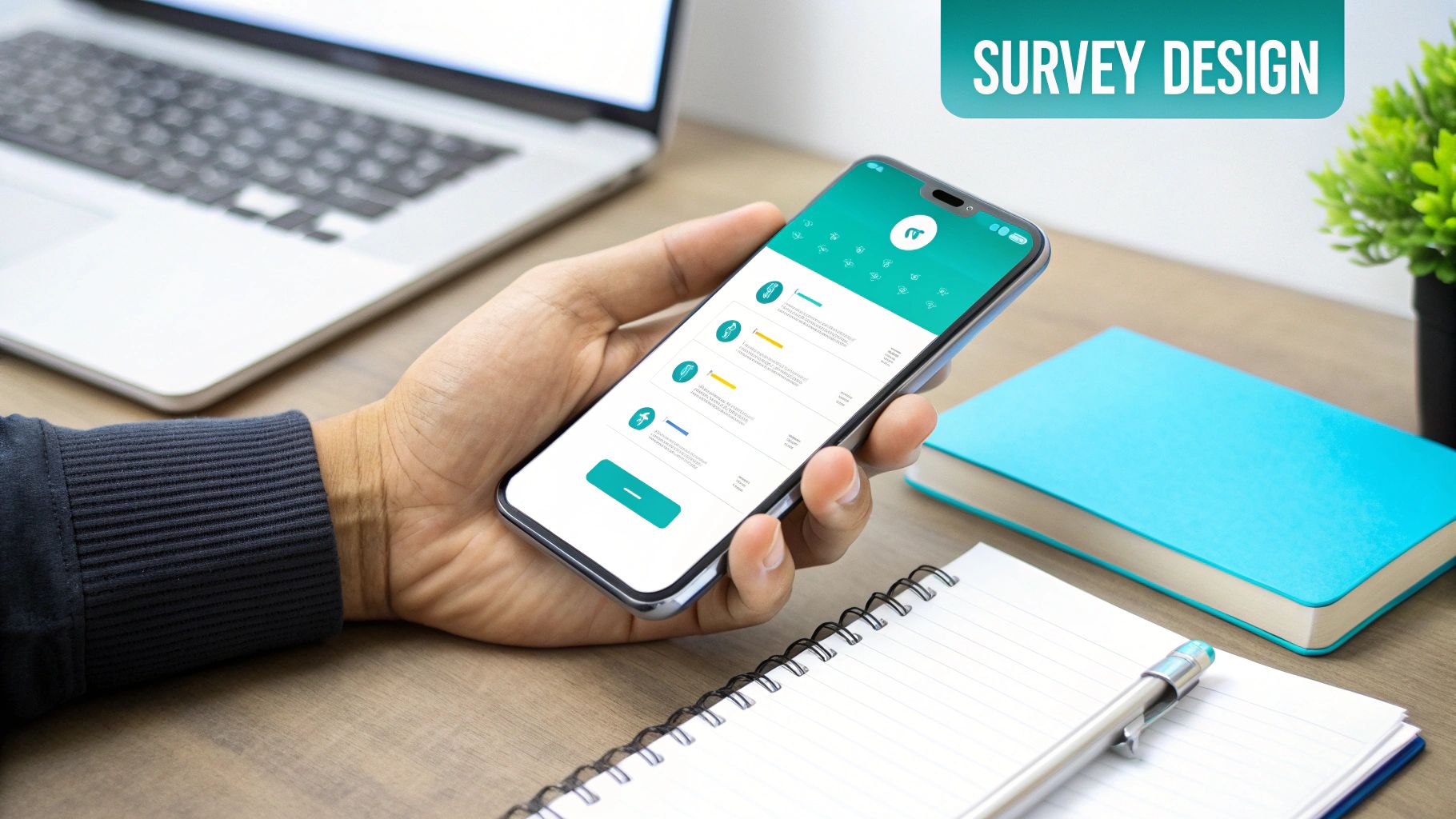
The survey's design has a massive impact on whether people actually finish it, especially on mobile, where patience is thin. We've all seen them: traditional, multi-page forms that feel like homework. A long list of questions on a tiny screen is a surefire way to get people to abandon it.
The modern alternative is the conversational survey. It turns the whole experience into a natural dialogue, asking one simple question at a time. It feels less like an interrogation and more like a quick chat.
This approach is a game-changer for improving your NPS score because it just feels easier for the customer. Research from Forrester paints a clear picture: NPS scores recently dipped across eight major industries, and the brands staying on top are the ones who excel at keeping their Promoters happy. A superior user experience, like what conversational forms offer, is a huge part of that. Your Promoters are your champions, driving 51-77% of referrals, so making it effortless for them to give feedback is a massive competitive advantage.
A Checklist for a Better NPS Survey
To make sure your survey is set up to capture the most valuable feedback, check out these 8 powerful NPS question examples and run through this quick audit of your current setup:
- Is it mobile-first? The experience has to be seamless on a smartphone. No pinching and zooming.
- Is the timing right? Are you asking at a moment of peak relevance?
- Is it conversational? Does it feel like a simple, back-and-forth chat?
- Is the follow-up question open-ended? The real insights are in the "why." Always ask something like, "What’s the main reason for your score?"
- Is it branded and trustworthy? The survey should look and feel like it comes from you, building trust and encouraging responses.
Boosting Response Rates with a Better Survey Experience
A low NPS response rate isn't just a disappointing number—it's a critical blind spot. When only a small fraction of your customers reply, the data you get can be dangerously skewed, painting a distorted picture of what people actually think. To really move the needle on your NPS score, you first have to get more people to share their feedback. That means doing more than just sending another email blast.
The real key is designing a survey experience that feels effortless, engaging, and respects your customer's time. A clunky, multi-page form on a phone is an instant no. The modern approach is to completely rethink the data collection process itself.

Embrace Conversational Surveys
What if your survey felt less like a form and more like a simple, back-and-forth chat? That's the idea behind a conversational form. Instead of hitting users with a long list of questions all at once, it asks them one at a time, just like a real conversation. This approach is far less intimidating and is a perfect fit for mobile users who live in chat apps.
This small shift can have a massive impact on participation. We've seen companies get much higher completion rates and quicker responses just by making the experience feel more natural and less like a chore.
Conversational forms can deliver higher completion rates compared to traditional forms. The experience is faster and more intuitive, especially on mobile, where the majority of users interact with surveys.
When you make it this easy for someone to respond, they're far more likely to do it. If a customer feels like they’re just answering a quick text, their willingness to participate skyrockets.
Frame the Question with a Human Touch
How you ask is just as important as what you ask. A cold, robotic intro will kill engagement before the survey even starts. A friendly, personalized opening, on the other hand, sets a completely different tone.
Instead of a generic "Please rate our service," try something warmer:
- "Hi [Customer Name], we'd love your quick thoughts on your recent purchase. It'll only take a moment."
- "Thanks for being a customer! Could you help us improve by answering one quick question?"
- "Your feedback is super valuable to our team. How likely are you to recommend us?"
This simple change makes the interaction feel more personal and shows you respect their time. It signals that you value their opinion, not just their data point. Getting this right is crucial, and you can find more inspiration by reviewing various examples of effective survey questions to see what fits your brand’s voice.
Personalize the Survey Flow
A truly great survey experience adapts to the user's answers in real time. Using smart logic, you can create a personalized path that feels intelligent and responsive, not rigid and static.
For example, if a customer gives you a 9 or 10 (a Promoter), the follow-up question can be celebratory: "That's fantastic to hear! What did you love most about your experience?"
But if a customer gives a score of 6 or below (a Detractor), the next question should be empathetic and action-oriented: "We're sorry to hear that. Could you tell us what we could do to make things right?"
This kind of intelligent routing accomplishes two critical things:
- It gathers more relevant feedback. You get specific praise from Promoters and actionable criticism from Detractors.
- It shows the customer you're actually listening. The survey feels like it's responding to them, which makes them more invested in giving a thoughtful answer.
Ultimately, your goal is to design a feedback process so seamless and pleasant that customers are happy to participate. When you make it easy and rewarding for them to share their voice, you'll not only see your response rates climb but also gather the rich, detailed insights you need to make real improvements and raise that NPS score.
Turning Raw Feedback into Actionable Insights
Collecting NPS scores is just the starting line. A score of 2 or 9 tells you what a customer feels, but the real gold is buried in their comments—that’s where you find the why. The real work begins when you turn that mountain of raw, unstructured feedback into a clear, prioritized action plan.

Let's be honest, qualitative data can be a mess. Those open-ended comments are filled with emotion, typos, and unique phrasing that can feel overwhelming. Without a structured approach, it’s easy to get lost in the noise and miss the critical patterns that point to high-impact improvements.
Segment Your Feedback for Deeper Understanding
Not all feedback is created equal. A Detractor who just signed up has a completely different set of problems than a Promoter who's been a loyal customer for five years. To make any sense of the noise, you absolutely must segment your responses. This is how you start seeing the complete picture.
I recommend grouping feedback based on meaningful customer attributes:
- Customer Lifecycle Stage: Are new users hitting a wall during onboarding? Are long-time customers getting frustrated by a recent update?
- User Persona: Does your "Small Business Owner" persona absolutely love the product, while your "Enterprise Manager" persona finds it lacks critical features?
- Product Usage Data: Are the people who use Feature X overwhelmingly Promoters? Do Detractors tend to avoid a certain part of your product?
- Plan or Tier: Do customers on your premium plan have wildly different expectations (and pain points) than those on your free plan?
Segmenting like this stops you from making broad, generalized decisions for an "average" customer who doesn't actually exist. Instead, you can pinpoint exactly which groups are your biggest fans and which are at risk of churning, allowing for much more targeted and effective action.
Uncovering Themes in Qualitative Comments
Once you've sliced your feedback into segments, it’s time to dive into the actual comments. Your goal here is to move beyond individual complaints and identify the recurring themes. This is how you transform anecdotal evidence into quantifiable issues your team can actually prioritize and solve.
A straightforward method is to tag comments with keywords or categories. You might create tags like "buggy," "slow performance," "missing integration," "great support," or "easy to use." As you review comments from Detractors, Passives, and Promoters, you'll quickly see which tags pop up most often for each group.
Key Takeaway: You might discover that 80% of your Detractors mention "slow performance," while your Promoters consistently praise your "great support." That single insight immediately tells you where to focus your engineering resources for the biggest possible impact on your NPS score.
This process essentially quantifies your qualitative data. Instead of saying, "some people think the app is slow," you can now say, "performance issues were mentioned in four out of five negative comments from our enterprise users." Now that is a problem statement a product team can sink its teeth into. If you're looking to refine how you gather this information from the start, check out these useful tips on how to collect customer feedback.
Building Your Feedback Analysis Framework
A structured framework is your best friend in this process. It ensures no insight gets missed and that your analysis actually leads to a prioritized action plan. It's all about connecting the dots between what customers are saying and what your business should do about it.
I've found that organizing your findings in a simple table works wonders. This format makes it easy for stakeholders across different departments—from product to marketing to support—to understand the key takeaways at a glance.
Here's a look at an actionable framework you can adapt.
NPS Feedback Analysis Framework
This structured approach helps teams segment and analyze NPS feedback to pinpoint the most critical areas for improvement.
| Feedback Segment | Key Themes from Promoters | Key Themes from Passives | Key Themes from Detractors | Actionable Insight |
|---|---|---|---|---|
| New Users (First 30 Days) | "The onboarding was so simple and easy to follow." | "It's okay, but some parts were confusing." | "I got stuck setting up my first project and couldn't find help." | Opportunity: Improve the in-app guidance for first-time project setup. |
| Power Users (High Usage) | "The advanced reporting feature saves me hours every week." | "It works, but it could be faster." | "The software is too slow when I have a lot of data loaded." | Risk: Address performance bottlenecks to retain high-value customers. |
| Mobile App Users | "Love being able to check my dashboard on the go." | "Wish it had all the features from the website." | "The mobile app is missing key features from the desktop version." | Gap: Prioritize feature parity between the mobile and desktop experiences. |
By translating raw comments into a structured format like this, you create a powerful tool for decision-making. It clarifies what you should double down on (what Promoters love) and what you absolutely must fix (what Detractors hate). This focused approach is the foundation for any strategy that aims to systematically improve an NPS score.
Closing the Loop to Build Customer Loyalty
Getting feedback is just the start. The real magic—and where most companies drop the ball—is in “closing the loop” by following up with every single person who responds. When a customer gives you a score, they're opening a door to a conversation. Ignoring them slams it shut. Replying shows you're actually listening.
This isn't just about putting out fires. It's a powerful way to build real relationships, turn frustrated critics into fans, and give your happiest customers a megaphone. A quick, personal message can completely change how a customer feels about a bad experience and prove you’re a company that cares.
A Tailored Approach for Every Respondent
You can't use a generic, copy-paste reply for everyone. To do this right, you need a different game plan for each of the three NPS groups: Promoters, Passives, and Detractors. Each one needs a unique tone and a clear goal.
- Promoters (Score 9-10): These are your biggest fans. The goal is simple: thank them and activate them. Show your genuine appreciation and make it easy for them to spread the word.
- Passives (Score 7-8): These customers are on the fence—they're satisfied, but not wowed. The goal is discovery. You need to figure out what's holding them back from being true loyalists.
- Detractors (Score 0-6): These are your at-risk customers. The goal is immediate resolution. Your response has to be fast, empathetic, and focused on fixing the problem.
Segmenting your follow-up like this makes every interaction feel relevant and personal.
Responding to Detractors Immediately
When a Detractor leaves a low score, the clock is officially ticking. A fast, human response is your best shot at saving the relationship. It's wild, but research has shown that customers who have a problem resolved quickly often become more loyal than those who never had an issue at all.
Your outreach needs to feel like it came from a real person, not a bot. Here’s a simple script you can adapt for an email or chat message:
"Hi [Customer Name], this is [Your Name] from the customer team at [Your Company]. I just saw your feedback and wanted to reach out personally. I'm really sorry to hear about the frustrating experience you had, and I'd love to learn more about what happened so I can make it right."
This simple message does three things perfectly: it acknowledges their specific feedback, it offers a real apology, and it opens a dialogue. That's the first step to turning a bad situation around.
Engaging Passives and Mobilizing Promoters
While Detractors are the most urgent, don't forget about your other two groups. They hold a ton of potential.
Engaging Passives helps you find the gap between a "good enough" experience and a "great" one. Just ask them one simple, open-ended question: "What's one thing we could do to earn a 10 from you next time?" Their answers are often pure gold, revealing small friction points you never knew existed.
With Promoters, the follow-up is all about gratitude and advocacy. Thank them warmly, and then make a specific ask. Could they write a review on G2? Would they be open to being featured in a case study? Do they know anyone who could benefit from your product?
Promoters are your most powerful marketing channel. Bain's research found they drive nearly seven times as many referrals as Detractors and have one-third lower churn. This is where you see the direct line connecting your NPS efforts to real business growth.
To really dig in and build a program that fosters this kind of loyalty, it's worth exploring modern loyalty marketing strategies. Ultimately, closing the loop isn't just a task for the support team—it's a core growth strategy that pays off in both customer happiness and revenue.
Building a System for Continuous NPS Improvement
Let's get one thing straight: improving your NPS score isn't a one-off project you can check off a list. It's not a quarterly campaign, either. It’s a fundamental business process that demands a sustainable, ongoing system. One-time fixes might give you a temporary bump, but real, lasting improvement only happens when customer feedback is woven into the very fabric of your company.
This means you have to move beyond just collecting scores. You need to build a culture of continuous listening, learning, and—most importantly—acting.
The first move is to treat your NPS program with the same respect you give any other critical business function. It needs clear ownership, defined goals, and a regular rhythm for review and action. Without that structure, feedback just gets lost in the noise, insights go stale, and all that initial momentum fizzles out. A solid system makes sure every piece of feedback becomes a catalyst for real change.
Setting Realistic Goals and Tracking Progress
"We want a higher NPS" is a wish, not a goal. To actually get anywhere, you need specific, measurable targets. A great starting point is to benchmark where you are right now and aim for a steady, incremental increase. Think in terms of a 5-10 point improvement each quarter. It's ambitious but achievable.
Once you have a target, you need a way to track it. This is where a good dashboard is non-negotiable. A well-designed dashboard gives your team an at-a-glance view of the metrics that matter most:
- Overall NPS Trend: Is your score trending up, down, or just sitting there?
- Scores by Segment: How do new users feel compared to your veterans? Are your mobile app users happier than desktop users?
- Response Volume: Are you actually getting enough feedback to make confident decisions?
Using a tool with real-time analytics lets you monitor these trends as they happen. That immediate visibility is gold because it helps you validate the impact of your changes. You can finally answer the crucial question: "Did that product update we shipped last month actually make customers happier?"
Connecting NPS to Business Outcomes
To get real buy-in across the organization—from the C-suite to the front lines—you have to connect NPS directly to the bottom line. A rising score isn't just a vanity metric; it’s a powerful leading indicator of your company's health.
Key Insight: NPS is a powerful predictor of future growth. A rising score should correlate with positive trends in customer retention, churn reduction, and increased lifetime value (LTV). When you can show that a 10-point NPS increase leads to a 5% reduction in churn, customer feedback becomes a priority for everyone.
Take the global business community REF, for example. They successfully boosted their NPS from a solid 56 to an excellent 67 by making strategic changes based directly on what their customers were telling them. That 11-point jump shows how targeted investments in the customer experience can drive world-class scores and signal real progress toward revenue growth. You can read more about how they achieved this NPS increase on ref.global.
This whole process is about creating a feedback loop, where you systematically handle what you hear from each customer segment—Promoters, Passives, and Detractors—to keep getting better.
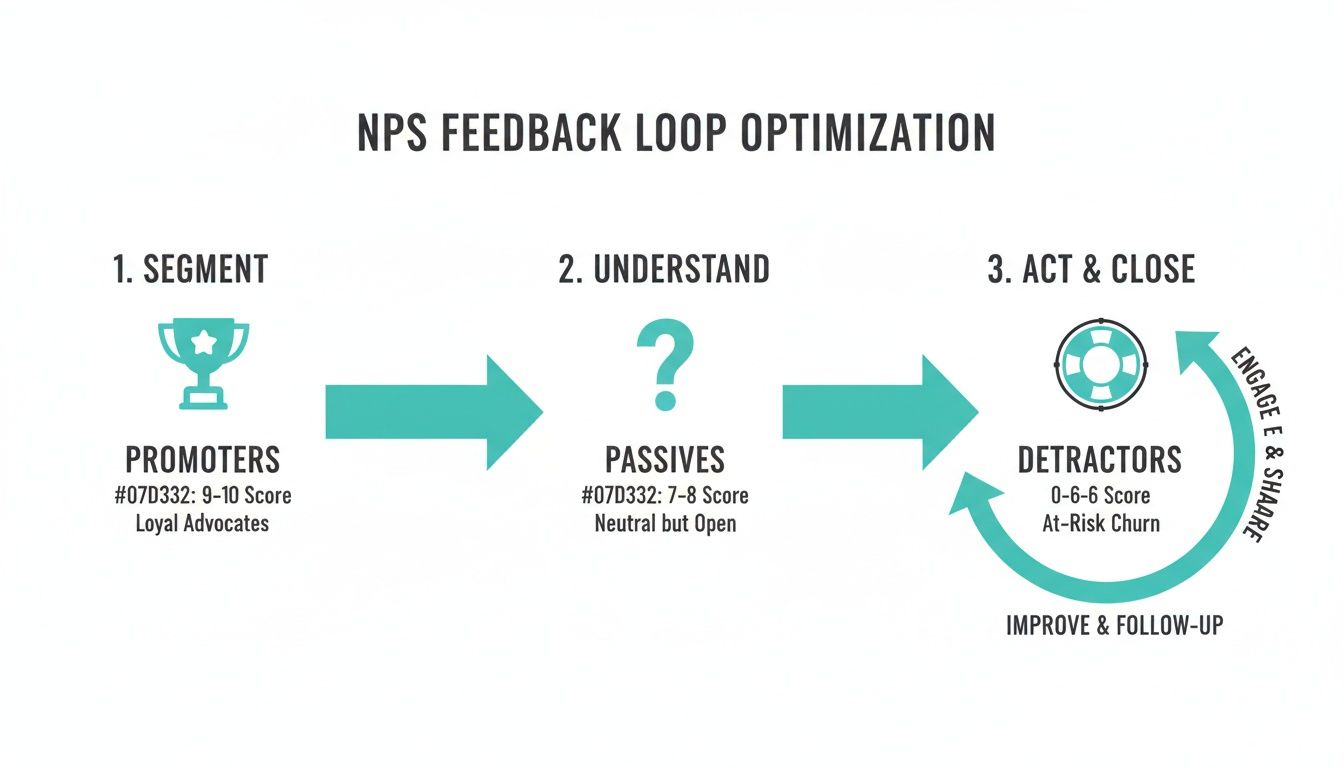
The image above nails it: each group needs a different playbook. You want to amplify your Promoters, nudge your Passives, and rescue your Detractors. That's how you create a virtuous cycle of improvement.
Creating a Culture of Accountability
At the end of the day, building this system is about fostering a culture of accountability. Customer feedback can't just live in a silo, owned by one person or a single team. It has to be shared widely and plugged into every department's workflow.
Here’s how you can start building that accountability:
- Assign Clear Ownership: Make it crystal clear who is responsible for following up on different types of feedback. Maybe the product team owns all feature requests, while the support team handles service issues.
- Share Insights Often: Get into a rhythm of brief, regular meetings (weekly or bi-weekly) to review new NPS feedback. Talk about the trends and assign clear action items right then and there.
- Celebrate the Wins: When a change driven by customer feedback pays off—like a jump in the NPS score for a specific segment—make a big deal out of it. Share it publicly.
By making customer feedback a visible and shared responsibility, you ensure your efforts turn into measurable success. This transforms NPS from a simple metric into the engine that drives your entire customer experience strategy.
Common NPS Questions Answered
Even the best-laid plans run into questions on the ground. When you're in the trenches trying to move your NPS score, specific challenges always come up. Getting straight answers to these common questions can save you a ton of time and help you sidestep a few classic mistakes.
Think of this as your go-to cheat sheet for fine-tuning your NPS program. Let's dive into some of the things teams ask most often.
How Often Should We Actually Send an NPS Survey?
Figuring out the right survey timing is a delicate dance. You need fresh, timely feedback, but you absolutely can't afford to burn out your customers with endless requests. There’s no magic number here, but your business model gives you some major clues.
- For transactional businesses, like an e-commerce shop, the sweet spot is usually a few days after the customer receives their order. Their impression of the product and the delivery experience is still top-of-mind.
- For subscription models (like most SaaS), a quarterly or bi-annual check-in works well. This cadence is great for tracking loyalty and overall sentiment as customers use your product over the long haul.
- Trigger-based surveys are your secret weapon. Don't just survey on a schedule; survey at key moments. Think about sending a quick poll right after a customer support ticket is closed or as soon as a user finishes their onboarding. The feedback you get is incredibly specific and tied to a real experience.
The big takeaway? Tie your surveys to meaningful touchpoints in the customer journey. Randomly blasting out surveys is just noise; strategic timing is where you get the gold.
What Is a "Good" NPS Score Anyway?
This is easily the most popular question, and the real answer is… it depends. A "good" score in one industry could be a disaster in another. Department stores, for instance, tend to have much higher scores than cable companies or airlines. Context is everything.
That said, here’s a general benchmark to give you a feel for where you stand:
- Anything above 0 is a good start. It means you have more fans than critics.
- Hitting 20 or higher is great. You've clearly got a healthy, happy customer base.
- Scores above 50 are excellent. This shows a deep, company-wide commitment to the customer experience.
- Reaching 80+ puts you in world-class territory. These are the brands with true superfans.
But honestly, the most important benchmark is your own progress. A steady 5-10 point improvement quarter-over-quarter is a much better sign of success than getting hung up on a competitor's score you saw in a report. Focus on beating your own last record.
How Can We Get More Than Just "It's Fine" in the Comments?
Let's be real: the score is just a number. The magic is in the open-ended comments—that’s where you find out why people feel the way they do. If you're getting one-word answers, you need to change your game.
Here are a few tactics that work wonders for encouraging richer feedback:
- Ask a better question. Ditch the generic "Any comments?" and ask something that makes people think. A simple switch to, "What's one thing we could do to make your experience even better?" can completely change the quality of your responses. It nudges them toward constructive ideas.
- Make it a conversation. People hate filling out forms, but they don't mind chatting. A survey that reveals one question at a time feels more like a text message exchange. This casual format often gets customers to open up and share their thoughts more freely.
- Prove you’re actually listening. When you follow up with customers and show them how their feedback led to a real change—a bug fix, a new feature, a policy update—they become much more likely to give you detailed feedback next time. They see that their voice actually leads to action.
Ready to transform how you collect customer feedback? Formbot helps you create conversational forms to gather better insights. Create engaging, chat-based surveys that deliver higher completion rates and richer insights, helping you truly understand your customers and improve your NPS score. Start building better forms for free.