An anonymous feedback form is a pretty simple concept: it’s a way for people, like your employees or customers, to share what’s on their mind without having to attach their name to it. This creates a sense of psychological safety, which is absolutely critical if you want to get at the unfiltered, honest truths that people are often too afraid to say out loud. By taking the fear of judgment or blowback off the table, you open the door to uncovering issues you never knew existed.
Why Honest Feedback Is Your Ultimate Growth Engine

Let's cut to the chase—the most useful insights are almost always the ones people are most hesitant to share. An anonymous feedback form isn't just a digital version of the old suggestion box; it's a strategic tool for getting ahead of problems and building a transparent culture where everyone feels like they have a voice.
When people are confident their identity is protected, they feel safe enough to be truly candid. This is how you discover hidden morale issues that are quietly sinking productivity or find out what’s really frustrating customers before they decide to leave.
Unlocking Unfiltered Truths
I saw this happen firsthand with a company that noticed a mysterious dip in team performance. Regular check-ins and one-on-ones weren't revealing anything. But after they rolled out an anonymous feedback system, the truth came pouring out: a new project management tool was causing widespread confusion and burnout.
Without that shield of anonymity, no one wanted to be the one to criticize a system management had just implemented. With it, leadership got the raw, actionable data they needed. They were able to offer better training and tweak workflows, which completely turned the productivity slide around.
"Anonymity empowers honesty. When people feel secure, they're more willing to share the constructive criticism and brilliant ideas that drive real progress. It's the difference between hearing what you want to hear and what you need to hear."
This shifts feedback from a dreaded formality into a constant, flowing source of innovation and improvement.
The Tangible Impact of Anonymity
The value of an anonymous feedback form isn't just a feel-good idea; it has a real, measurable impact on the bottom line. Research has shown time and again how these tools can help reduce turnover and spark new ideas.
When employees feel their voice is heard, they are more engaged and invested in the company's success. This is backed by broader research showing a strong link between employee engagement and key business outcomes. Organizations with engaged employees often see higher productivity, better retention rates, and increased profitability. You can dig deeper into how anonymous feedback impacts employee trust and engagement.
The connection is clear: giving people a safe channel to speak up directly contributes to a healthier, more productive, and more profitable company. It’s about building a system where problems are flagged early, great ideas can come from anywhere, and everyone feels invested in the company's success.
Designing a Form That Encourages Candor
Think of your feedback form's design as a silent conversation with your audience. If the layout is clunky or confusing, you're subconsciously telling them you don't value their time. A clean, intuitive interface, on the other hand, is a direct invitation to share openly. It’s often the one thing that separates thoughtful insights from a few half-finished responses.
The real goal is to make the entire experience feel less like a formal interrogation and more like a guided chat. This is where modern tools can make a huge difference, transforming a static page into a dynamic, one-question-at-a-time flow. I’ve found this conversational approach can seriously boost completion rates because it feels so much less overwhelming, especially for someone filling it out on their phone.
Blending Question Types for Richer Data
A great form rarely relies on just one type of question. If you only use open-ended questions, you might get vague feedback. If you only use rating scales, you'll miss the crucial "why" behind the scores. The magic happens when you blend them.
Here's how I typically approach it:
- Rating Scales (1-5 or 1-10): These are my go-to for getting hard numbers on specific topics. For a team pulse check, I might ask, "On a scale of 1 to 10, how manageable is your current workload?" This gives me a clear metric I can track over time.
- Multiple-Choice Questions: Perfect for segmenting data and spotting trends. After a client project, a question like, "Which part of our communication was most effective? (Weekly emails, Slack channel, Stand-up meetings)" helps pinpoint exactly what's working.
- Open-Ended Questions: This is where the real gold is. These questions uncover the context behind the numbers. A simple prompt like, "What's one thing we could do to improve our team meetings?" can unearth brilliant ideas you'd never think to ask about directly.
If you want to see how dedicated tools handle this, it's worth checking out different customer feedback survey solutions designed specifically for apps and websites.
The Power of Neutral Language
How you phrase a question has a massive impact on the answer you get. It’s so easy to accidentally ask a leading question, which steers people toward a certain response and taints your data. It's the difference between asking, "How great was our new onboarding process?" and "How would you describe your experience with our new onboarding process?"
The first question pressures the respondent to agree. The second one creates space for an honest, unbiased answer. I always do a final pass on my questions just to strip out any emotionally charged or leading language.
Here are a few examples to keep in mind:
| Biased Question | Neutral Alternative |
|---|---|
| Don't you agree our recent update was a huge improvement? | What are your thoughts on the recent product update? |
| What problems did you have with the project timeline? | Please share your feedback on the project timeline. |
| How much do you love the new flexible work policy? | On a scale of 1-10, how is the new work policy affecting you? |
Crafting an effective form is both an art and a science. For anyone looking to get started without reinventing the wheel, a pre-built customer feedback survey template can be a fantastic starting point. By thoughtfully combining the right question types with neutral language, your form becomes a powerful tool for gathering the candid, actionable insights you need to actually drive improvement.
Asking the Right Questions to Get Actionable Answers
The feedback you get is only as good as the questions you ask. It’s that simple. Your anonymous form is just the tool; the real magic lies in crafting questions that dig deep and deliver insights you can actually use. Vague questions will always get you vague, unhelpful answers. But when you ask something specific and thoughtful, you open the door to the kind of detailed feedback that sparks real change.
The trick is to start with a clear goal. What are you actually trying to learn? Are you trying to get a pulse on team morale, see how your managers are doing, or figure out why customers are getting stuck at a certain point in your product? Each of these goals requires a completely different approach to your questions.
Questions for Employee Engagement
If you want to boost employee engagement, you first have to understand what it’s really like to work at your company day-in and day-out. These questions are meant to get past the surface-level “Are you happy?” and uncover what truly motivates—or drains—your team. It’s about creating a safe channel for people to talk about workload, culture, and where they see their careers going.
- On a scale of 1-10, how manageable is your current workload?
- What is one thing we could do that would make your work here more enjoyable or fulfilling?
- Do you feel you have the right tools and resources to do your job well? If not, what’s missing?
- Is there anything holding you back from doing your best work?
I love this mix of a rating scale with open-ended questions. It gives you hard data to spot trends while also providing the personal stories that explain why those trends are happening.
Questions for Leadership Effectiveness
Good leadership can make or break a team, but getting honest feedback about managers is notoriously difficult. This is where an anonymous form truly shines, giving people the confidence to be candid without worrying about repercussions.
I've learned that effective leadership questions focus on specific behaviors and their impact. Don't ask, "Is your manager good?" That's way too subjective. Instead, ask about their communication style, how they provide support, and whether they give recognition.
Here are a few examples that tend to get clear, actionable feedback:
- Does your manager set clear goals and expectations for your role?
- How often do you get constructive feedback that helps you improve? (e.g., Regularly, Sometimes, Rarely, Never)
- Do you feel genuinely recognized and appreciated for your contributions?
- What’s one thing your manager could start doing to better support you and the team?
Questions for Customer Satisfaction
When you're gathering feedback from customers, your goal should be to understand their entire journey with your product or service. You’re not just hunting for bugs; you’re looking for friction points, moments of delight, and unmet needs.
- On a scale of 1 to 5, how easy was it to use our product/service?
- Was there any part of the process that you found confusing or frustrating?
- What was the main reason you decided to go with us instead of a competitor?
- If you had a magic wand and could change one thing about our product/service, what would it be and why?
Questions for Process Improvement
Believe me, the people doing the work every day have the best ideas for how to make it better. Anonymous feedback can uncover bottlenecks and inefficiencies that leaders are often too far removed to see. These questions are designed to invite practical suggestions about workflows, tools, and internal systems.
- What part of your daily or weekly workflow feels like the biggest time-sink?
- Do you have any ideas for making our team meetings more productive?
- Is there a process or task you think could be simplified or automated? How would you do it?
- What’s the biggest obstacle you run into when you need to collaborate with other teams?
Building Trust with True Anonymity
If people don't believe their feedback is truly anonymous, they simply won't be honest. It's a fundamental truth I've seen play out time and again. Building that foundation of trust is everything, and it rests on two pillars: solid technical safeguards and crystal-clear communication. Without both, your anonymous feedback form is just another box-ticking exercise that won't get you the candid insights you need.
The whole point of gathering feedback is to drive meaningful progress. That process starts with a clear goal, moves to asking the right questions, and, most importantly, ends with taking real action based on what you’ve learned.
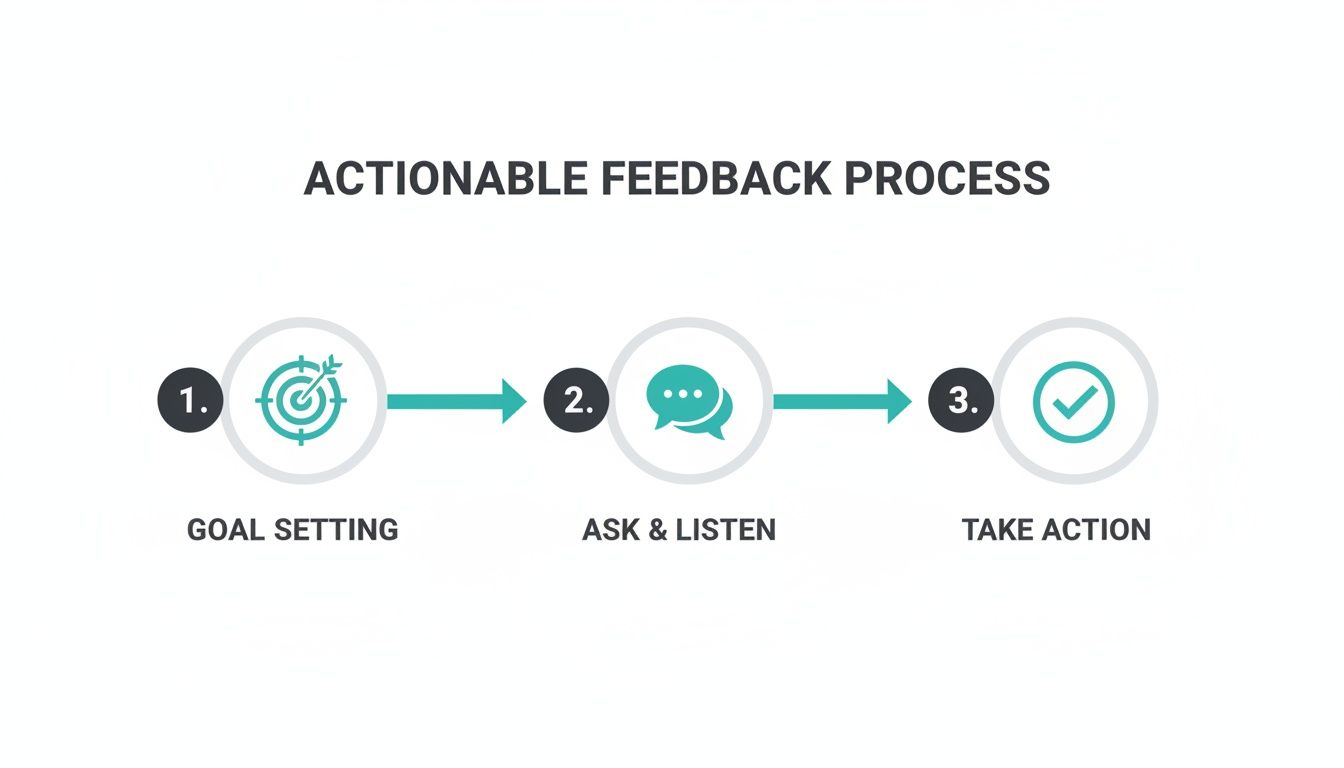
This process highlights a critical point: collecting feedback is just the middle step. The real value is unlocked when you set a clear objective beforehand and commit to concrete action afterward.
The Technical Side of Anonymity
To guarantee privacy, you have to get your hands dirty with the technical settings. Many online form builders, by default, quietly collect little breadcrumbs of data that could unintentionally identify a respondent, even if you never ask for their name.
Here are the key technical leaks you need to plug:
- IP Address Tracking: An IP address can easily reveal a user's general location or even their specific company network. This has to be switched off. No exceptions.
- Tracking Cookies: Pesky little cookies can link a user’s session on your form to their activity elsewhere. Your form tool shouldn't use any identifying cookies that could compromise anonymity.
- Required Logins: This one seems obvious, but it's a common mistake. If someone has to log into a company portal or a Google account to access the form, their submission is automatically tied to their identity.
Thankfully, good tools often handle this automatically, but you should always double-check. It's worth understanding how platforms approach this. For a deeper dive, you can explore the Formbot privacy policy to see how they outline their data handling practices.
Communicating Your Commitment
Once your form is technically secure, you have to tell people about it. Don’t just slap "Your feedback is anonymous" at the top and call it a day. Explain how you're protecting them. This isn't just a nice-to-have; it's essential. People will only share completely honest opinions when they are absolutely certain their anonymity is guaranteed.
A simple, upfront statement at the top of your form can make a world of difference: "This form is 100% anonymous. We do not track IP addresses, email addresses, or any other identifying information. Your honest feedback is valued and protected."
This kind of direct transparency creates the psychological safety needed for people to open up.
Another powerful practice I always recommend is setting an anonymity threshold. This is a commitment you make to only view aggregated data after a certain number of responses—say, five or ten—have been collected. This simple policy prevents managers from trying to connect the dots and figure out who said what, especially in smaller teams. It’s a small detail that provides a massive boost in trust.
Turning Raw Feedback into Real Change
You’ve collected the responses—great. But that’s just the starting line. Raw, unorganized data doesn't do anyone any good until you turn it into a clear plan for action. This is the part that truly matters: digging into the feedback, understanding what it means, and, most importantly, letting people know you heard them. It’s what separates a simple data-gathering exercise from a real engine for improvement.
Staring at a mountain of open-ended comments can feel a bit daunting. The secret is to resist the urge to get bogged down in every single comment right away. Instead, look for the big picture. Your first job is to spot the recurring patterns.
From Data Points to Actionable Themes
As you start reading through the submissions, you'll see common threads pop up again and again. Start grouping them into broad, practical categories. Think of them as buckets for sorting the feedback.
Your categories might look something like this:
- Tooling and Resources: Is everyone complaining about slow software or the need for a specific tool to do their job?
- Communication Gaps: Are people feeling out of the loop? Do comments mention unclear instructions or too few team check-ins?
- Workload and Well-being: You’ll quickly spot concerns about burnout, unrealistic deadlines, or a lack of work-life balance.
- Leadership and Management: Feedback often centers on manager support, a lack of recognition, or confusion about team goals.
Once you've collected the responses, your ability to effectively analyze survey data will make or break your efforts. You can even use simple sentiment analysis to quickly separate positive comments from urgent issues that need your immediate attention. This systematic approach keeps you from overreacting to a single outlier and helps you zero in on the areas where change will make the biggest difference. We cover some related concepts in our guide on how to collect customer feedback.
Closing the Feedback Loop
I can't stress this enough: this is the most critical part of the entire process. After you’ve identified the main themes and decided what to do, you absolutely must communicate this back to everyone. This one step proves that you were actually listening and that their input wasn't just shouted into the void.
Don't just collect feedback—act on it and announce it. A simple summary like, "We heard your concerns about meeting overload, so we're implementing 'no-meeting Fridays' starting next month," is incredibly powerful. It builds trust and is the best way to encourage participation next time.
The rise of the feedback software market shows that organizations are getting serious about this. When companies systematically act on feedback, they foster a culture of continuous improvement that drives better performance and innovation.
When people see that their anonymous feedback leads to real, tangible change, they become invested. They start to believe the process works, and that's when you start getting the truly honest insights that drive growth.
Common Questions About Anonymous Feedback Forms
Even with the best intentions, rolling out an anonymous feedback system can raise a few eyebrows. It’s smart to get ahead of these common questions. Tackling them openly builds the trust you need for people to actually participate. Let's walk through some of the most frequent ones I hear.
How Can I Encourage More People to Fill Out My Form?
Getting people to consistently share their thoughts is probably the biggest challenge. The single most powerful thing you can do? Prove you’re listening. When people see that their feedback actually leads to tangible changes, they suddenly become much more invested in the process.
Here are a few tactics that have worked for me:
- Explain the "Why" upfront. Before you even send the link, tell people what you're trying to achieve. Are you looking to make team meetings less of a drag? Trying to nail down a confusing product feature? Checking in on burnout levels? A little context goes a long way.
- Make it quick and easy. Your form should take just a few minutes, tops. And it absolutely has to work perfectly on a phone. Nobody wants to pinch and zoom through a clunky desktop form on their mobile device.
- Share what you learned (and what you'll do). This is the step everyone skips, but it's the most important. After a feedback round, send out a high-level summary of the themes you saw. More importantly, tell them exactly what actions you're taking. This closes the loop and is the best possible incentive for them to participate next time.
What Is the Best Way to Handle Harsh Anonymous Feedback?
Let’s be honest, harsh criticism stings. But it often contains the most valuable nuggets of truth. Your first instinct might be to get defensive or try to guess who said it. Don't. That immediately undermines the entire point of an anonymous feedback form.
Instead, shift your mindset and treat it like raw data. Is this just one person venting, or does this comment echo a broader sentiment you’ve seen elsewhere? I find it helpful to group really harsh comments with related, more constructively-phrased feedback. It helps you see the bigger picture.
Often, a blunt comment is just a poorly articulated version of a very real problem. Acknowledge the themes publicly, share your action plan, and you can turn even the sharpest criticism into a catalyst for real improvement.
Can Feedback Ever Be Truly Anonymous with a Company Tool?
The short answer is yes, but it hinges on two things: the right technology and an unshakable ethical commitment from leadership.
From a technical standpoint, the platform you use has to be set up to not collect personal identifiers for anonymous submissions. That means no IP addresses, no email addresses, no user logins.
True anonymity is built on trust, and trust is earned through transparency. Always add a clear privacy statement right on the form, explaining what data is (and isn't) being collected.
Using a well-regarded third-party tool like Formbot can add a layer of credibility, as it separates the data collection from your internal systems. But ultimately, the organization has to commit—publicly and privately—to a strict policy against ever trying to figure out who said what. When people truly believe you’ll honor that promise, you’ll get the honest feedback you’re looking for.
Ready to create forms that people actually enjoy filling out? Formbot's conversational forms are designed to boost completion rates and gather better data. Start building for free and turn your feedback into your greatest asset.