The Net Promoter Score (NPS) is more than just a number; it's a powerful tool for understanding customer loyalty and driving business growth. Yet, many companies struggle to get meaningful insights from their surveys, facing low response rates, vague feedback, and unactionable data. The difference between a stagnant NPS program and one that fuels growth lies in the details. A well-executed strategy is a core component of the complete Net Promoter System, turning simple feedback into a predictable engine for retention and expansion.
This guide moves beyond the basics to reveal 10 essential NPS survey best practices for 2026. You will learn precisely how to craft questions that elicit genuine responses, deploy surveys at the perfect moment in the customer journey, and analyze the data to uncover deep, actionable insights. We’ll cover everything from leveraging conversational interfaces for higher engagement to establishing closed-loop feedback systems that show customers you’re listening.
By implementing these strategies, you can gather not just scores, but stories. This transforms your NPS surveys from a routine check-in into a core driver of customer-centric improvement. Each practice is detailed with actionable steps, real-world examples, and implementation tips, including how modern tools can streamline the collection process. Forget generic advice; this is a blueprint for making your NPS program a true competitive advantage.
1. Keep NPS Surveys Short and Focused
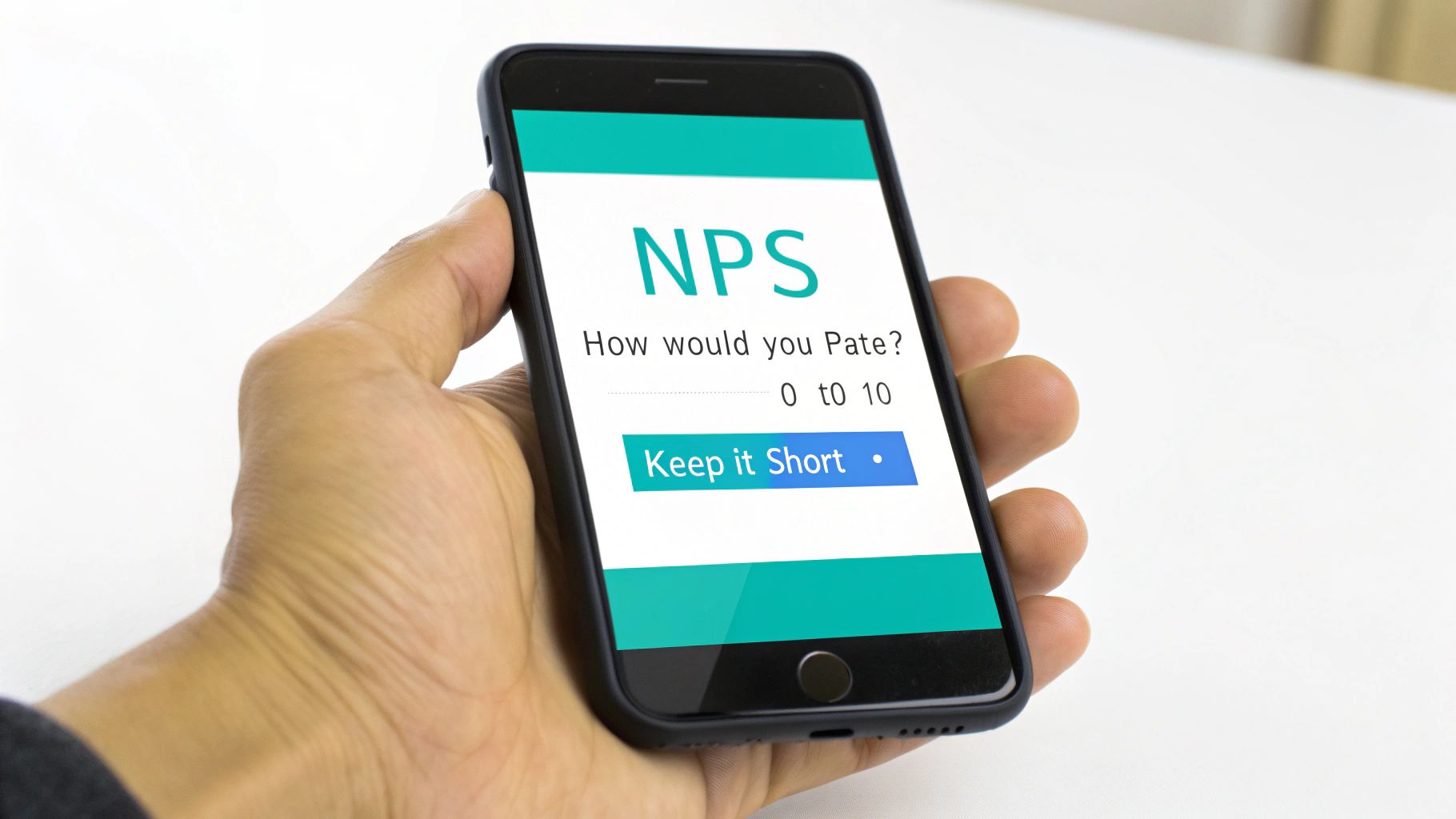
One of the most critical NPS survey best practices is respecting the respondent's time. In a world of constant digital interruptions, a long, complex survey is a guaranteed way to see response rates plummet. The core principle is to keep your survey concise and focused, asking only the most essential questions to gather actionable feedback without causing survey fatigue. A brief survey not only boosts completion rates but also often yields higher-quality, more thoughtful responses.
This approach centers on the standard NPS question: "On a scale of 0-10, how likely are you to recommend [Company/Product/Service] to a friend or colleague?" This is the non-negotiable heart of the survey. From there, limit yourself to a maximum of two or three carefully chosen follow-up questions. This ensures the entire experience feels quick and effortless, particularly for users on mobile devices where long forms are especially cumbersome.
Why Brevity Works
Companies like Apple and Dropbox excel at this. Apple often uses brief, in-app prompts after a support interaction or feature use, while Dropbox integrates minimalist feedback loops into its onboarding process. These surveys are effective because they are contextual and don't feel like a significant commitment. By asking for feedback immediately following a key action, the experience is fresh in the user's mind, leading to more accurate insights. The goal is to make providing feedback a seamless part of the user journey, not a disruptive task.
How to Implement This Practice
To put this into action, consider these actionable tips:
- Use Conditional Logic: A powerful technique is to use smart logic to show different follow-up questions based on the respondent's score. For example, you might ask detractors (0-6) "What can we do to improve your experience?" while asking promoters (9-10) "What did you like most about your experience?"
- Set the Expectation: For conversational surveys, a simple introduction like, "Help us improve by sharing your feedback (it only takes a minute)" can significantly increase engagement by managing expectations.
- Optimize the Flow: Instead of presenting all questions at once, use a one-question-at-a-time flow. This approach reduces cognitive load and makes the process feel more like a conversation, which can improve completion rates. For inspiration, you can explore various pre-built designs and learn more about effective NPS survey templates.
2. Use Conversational and Chat-Based Interfaces for Higher Engagement
Moving beyond static forms is another key NPS survey best practice that significantly boosts engagement. Conversational, chat-style surveys mimic a natural dialogue, making the feedback process feel less like a chore and more like a friendly conversation. This approach reduces the cognitive friction often associated with traditional forms and has been shown to increase completion rates, especially on mobile devices where users prefer quick, interactive experiences.
Instead of presenting a list of questions, a chat-based survey reveals one question at a time, guiding the user through the process in a personable way. This interactive flow keeps respondents focused and can lead to more thoughtful, candid answers. The entire experience feels more human and less transactional, which is crucial when asking customers to share their valuable opinions about your brand.

Why Conversational Works
Companies like HubSpot and Intercom have successfully integrated conversational interfaces into their feedback collection strategies. HubSpot uses chatbots to trigger NPS surveys contextually within their app, while Intercom leverages its messenger to gather feedback in a familiar, chat-based environment. These methods work because they meet customers where they already are and use an interaction style that is intuitive and low-effort. The result is a smoother user experience and a higher volume of valuable feedback.
How to Implement This Practice
To adopt a conversational approach for your NPS surveys, consider these actionable strategies:
- Write Like a Human: Use a friendly, second-person tone ("you," "your") and encouraging language. Phrase questions like "What’s the main reason for your score?" instead of a more robotic "Please provide the reason for your score."
- Embrace Micro-interactions: Incorporate elements like typing indicators, emojis, and progress bars to make the interaction feel more dynamic and alive. However, be careful not to overdo it and distract from the core purpose of the survey.
- Optimize for Mobile First: Design and test your conversational survey on the smallest screens first. A chat-like interface is naturally suited for mobile, ensuring a seamless experience for a majority of users.
- Leverage Chat-Based Tools: Platforms like Formbot are designed to create these experiences easily. Using a chat-based mode for your NPS survey can immediately give you the conversational advantage without needing complex development work. To dive deeper into this methodology, you can read about the principles of what is conversational design.
3. Segment and Personalize Survey Timing and Questions
A one-size-fits-all approach to NPS rarely works. One of the most impactful NPS survey best practices is to segment your audience and personalize the survey experience. This means tailoring not only the timing of your survey but also the follow-up questions based on specific user characteristics like their role, usage level, or tenure. A personalized survey feels more relevant to the recipient, which dramatically increases engagement and yields far more specific, actionable insights.
Treating all customers as a single monolithic group ignores the diverse ways they interact with your product or service. A brand-new user has a completely different perspective than a power user who has been with you for years. By segmenting, you can ask questions that directly relate to their unique journey, showing them you understand and value their specific experience. This targeted approach is key to unlocking deeper feedback.
Why Personalization Works
Companies like Salesforce and Amazon master this technique. Salesforce sends different NPS surveys to system administrators versus end-users, as their needs and product interactions are fundamentally different. Similarly, Amazon might ask a new Prime member about their onboarding experience, while a long-term customer might receive questions related to new features or delivery consistency. This relevance ensures the feedback gathered is context-rich and directly applicable to improving specific parts of the customer journey.
How to Implement This Practice
To effectively segment and personalize your NPS surveys, follow these actionable steps:
- Identify Key Segments: Start by defining 3-5 critical customer segments that are most meaningful to your business. This could be based on user roles (e.g., admin vs. user), subscription tier (e.g., free vs. enterprise), or product usage (e.g., high-activity vs. low-activity).
- Use Conditional Logic: Leverage smart branching logic to create dynamic question flows. For example, if a user indicates they are a "Marketing Manager," you can ask a follow-up question specific to marketing-related features, making the feedback instantly more valuable.
- Include Segment Metadata: When analyzing results, make sure to include segment data. This allows you to track NPS by cohort over time, revealing trends like whether your score is improving with a specific user group or declining after a product update.
- Balance Complexity: While personalization is powerful, avoid creating an unmanageable number of survey variations. Start with your most important segments and expand gradually to maintain operational simplicity.
4. Distribute Surveys at Moment-of-Truth Timing
Timing is everything when it comes to collecting meaningful feedback, which makes this one of the most impactful NPS survey best practices to implement. A "moment-of-truth" survey is triggered immediately after a key interaction, capturing the customer's sentiment while the experience is still fresh. This immediacy leads to dramatically higher response rates and more accurate, detailed qualitative feedback compared to surveys sent hours or days later.
The core idea is to align the survey with a critical point in the customer journey. By doing so, you connect the feedback directly to a specific action, making the insights far more granular and actionable. Waiting too long allows the memory of the experience to fade, which can lead to vague or generalized responses that are less helpful for pinpointing areas of improvement or success.

Why Moment-of-Truth Timing Works
Leading companies masterfully leverage this strategy. Uber’s post-ride survey, sent the moment a trip ends, is a prime example of capturing immediate sentiment. Similarly, Zendesk sends a feedback request right after a support ticket is resolved, and Amazon prompts for a review shortly after a purchase is completed. These companies understand that the best time to ask for feedback is when the value (or pain point) of their service is at its peak in the customer's mind. This contextual relevance makes the user more likely to respond and provide specific, high-quality insights.
How to Implement This Practice
To effectively use moment-of-truth timing, follow these actionable tips:
- Map Your Key Moments: Identify the most critical touchpoints in your customer journey. These could include onboarding completion, a successful purchase, a support ticket resolution, or achieving a key milestone with a feature.
- Prevent Survey Fatigue: Implement strict frequency caps to avoid overwhelming your users. A good rule of thumb is to limit surveys to a maximum of one per user per week or month, depending on your interaction frequency.
- A/B Test Your Timing: Don't just assume immediate is best for every scenario. Test different delays to find the sweet spot for your audience. Compare response rates and feedback quality between surveys sent immediately, one hour later, and 24 hours later.
- Use Conditional Triggers: Segment your audience and set up rules to only trigger surveys for specific user cohorts or after certain actions. This ensures you are asking the right person the right question at the right time.
5. Implement Response Rate Tracking and Optimization
One of the most essential NPS survey best practices is moving beyond a "set it and forget it" mentality. Simply sending surveys isn't enough; you must actively monitor their performance. Tracking response and completion rates across different channels and segments is crucial for understanding what works, identifying issues early, and maximizing the volume of feedback you collect. Continuous optimization based on this data is what separates good NPS programs from great ones.
This practice involves establishing a system to monitor key performance indicators (KPIs) for your surveys in real-time. This data allows you to see how different audiences respond to various delivery methods, timings, and designs. By analyzing these metrics, you can make informed adjustments to your strategy, ensuring you achieve the highest possible engagement and gather a representative sample of customer feedback. A low response rate can signal a problem with your survey's design, distribution channel, or audience targeting.
Why Tracking Works
Platforms like HubSpot and Intercom provide robust analytics dashboards that allow teams to visualize survey performance instantly. They can see response rates broken down by channel (email vs. in-app), customer segment, or even device type. This level of insight enables them to quickly diagnose problems, such as an email campaign underperforming or a mobile design flaw causing high abandonment rates. By continuously monitoring and reacting to these metrics, they ensure their feedback loop remains healthy and effective.
How to Implement This Practice
To put this into action, consider these actionable tips:
- Set Clear Targets: Establish a baseline and set ambitious but realistic response rate goals. For conversational surveys, aiming for 20% or higher is a great starting point.
- Segment Your Dashboards: Create analytics dashboards that segment performance by key variables like distribution channel, user segment, time period, and device type. This helps pinpoint specific areas for improvement.
- Track Beyond Response Rate: Monitor not just the initial response rate but also the completion rate and question-by-question dropout. This helps identify if a specific follow-up question is causing users to abandon the survey.
- A/B Test Your Channels: Implement A/B tests to compare the effectiveness of different distribution methods, such as email versus in-app pop-ups, to identify the optimal approach for different segments. To dive deeper into this topic, explore these proven tactics for increasing survey response rates.
- Establish Automated Alerts: Configure alerts to notify your team when response rates drop below a predetermined threshold. This allows you to address potential issues proactively before they impact your data collection.
6. Create Specific, Actionable Follow-Up Questions
A core tenet of effective NPS survey best practices is moving beyond the number score to understand the "why" behind it. Simply collecting a rating isn't enough; the true value lies in the qualitative feedback that explains the customer's sentiment. Designing specific, actionable follow-up questions tailored to the respondent's score is crucial for uncovering root causes and identifying clear paths for improvement. This targeted approach transforms raw data into a strategic asset.
The best practice is to segment follow-up questions based on the three NPS categories: detractors (0-6), passives (7-8), and promoters (9-10). Asking a promoter "What can we improve?" is a missed opportunity, just as asking a detractor "What did you like?" might be unhelpful. Tailoring the question to the user's mindset dramatically increases the relevance and usefulness of their response, giving you precise insights to act upon.
Why Tiered Follow-Ups Work
Companies known for their customer-centricity, like Slack and Intercom, excel at this. Slack famously asks promoters, "What's working well?" to identify key strengths, while asking detractors, "What frustrated you?" to pinpoint specific pain points. Similarly, Intercom often uses a direct question like, "What's one thing we could improve?" for scores from 0-8. This score-tiered strategy ensures the feedback is contextual, making it easier to prioritize product improvements, refine customer service protocols, or double down on features that customers already love.
How to Implement This Practice
To put this powerful technique into action, focus on crafting the right question for each segment:
- For Detractors (0-6): Your goal is to understand the core problem. Ask a direct, open-ended question like, "What is the main reason for your score?" or "What was missing or disappointing in your experience with us?"
- For Passives (7-8): These customers are content but not enthusiastic. You need to discover what it would take to "wow" them. Try asking, "What would turn your experience from good to great?" or "What one thing could we do to make you more likely to recommend us?"
- For Promoters (9-10): Uncover what you're doing right so you can replicate it. Ask questions like, "What did you like most about your experience with [Product/Service]?" or "What specific feature do you find most valuable?"
- Use Conditional Logic: A tool like Formbot allows you to easily implement conditional branching. You can set up rules that automatically show a specific follow-up question based on the numerical score the user selects, creating a seamless and intelligent survey experience.
7. Analyze NPS Data by Cohort and Trend Over Time
One of the most powerful NPS survey best practices is moving beyond a single, aggregate score and analyzing your data over time and across specific customer groups. A company-wide NPS score is a useful health metric, but it often hides crucial details. By segmenting respondents into cohorts and tracking their scores over time, you can uncover which customer segments are driving your overall score and measure the true impact of product or service changes.
This approach involves two key components: cohort analysis (grouping customers by shared characteristics like sign-up date, subscription plan, or geography) and trend analysis (monitoring how the NPS for these specific groups changes over weeks, months, or quarters). This gives you a much clearer, more granular view of customer sentiment, allowing you to validate improvements and identify at-risk segments before they become a larger problem.
Why Segmentation and Trending Works
Companies like Stripe and Zendesk use this method to great effect. Stripe analyzes NPS by customer size and geography to understand how its platform serves different market segments. Zendesk tracks NPS by product tier and region, helping them pinpoint where they need to invest in support or product localization. This deep analysis reveals if a new feature rollout positively impacted enterprise users while inadvertently creating friction for SMBs, an insight impossible to gain from a single, blended score.
How to Implement This Practice
To put this into action, consider these actionable tips:
- Establish Key Segments: Start by creating dashboard views for your most critical cohorts, such as by customer tier (e.g., Free, Pro, Enterprise), onboarding date, or product usage level.
- Track Consistently: Measure NPS on a consistent cadence, like monthly, but report on it quarterly. This helps smooth out temporary fluctuations and reveals more meaningful long-term trends.
- Investigate Deviations: Set up alerts or regular reviews to investigate whenever a specific cohort's NPS deviates significantly (e.g., more than 10 points) from the overall average. This is often the first sign of a segment-specific issue.
- Correlate with Actions: Before launching a new feature or policy change, establish a baseline NPS for the affected segment. After the launch, track the score to measure the lift and validate the initiative's success. To truly understand the "why" behind score changes and turn raw feedback into actionable intelligence, it's essential to learn how to effectively analyze qualitative data from open-ended comments.
8. Close the Loop with Rapid Response and Visible Action
One of the most impactful NPS survey best practices is what you do after the feedback is collected. Simply gathering scores is a wasted effort; the real value lies in responding to that feedback and visibly acting on it. Closing the loop means ensuring every respondent, especially a detractor, feels heard and that their input has a tangible effect on your product or service. This process builds immense trust, increases customer loyalty, and boosts future survey engagement.
When customers see that their feedback leads to real change, they are more likely to provide it again in the future. This transforms the NPS survey from a simple data collection tool into a powerful customer relationship and retention engine. Acknowledging feedback and demonstrating progress shows customers you are listening and committed to improving their experience, which can significantly move your overall NPS score over time.
Why Closing the Loop Works
Companies like Notion and Slack master this by connecting user feedback directly to their development cycle. Notion’s public changelogs often reference frequently requested features, making users feel like co-creators. Slack is known for its rapid and personal outreach to detractors, where support or product teams engage directly to understand issues. This not only helps solve immediate problems but also gathers invaluable qualitative data for long-term improvements. This transparent approach reinforces that customer feedback is a core part of their growth strategy.
How to Implement This Practice
To build a robust feedback loop, consider these actionable strategies:
- Create Automated Workflows: Set up a system where an NPS score triggers a specific action. For detractors (0-6), this could be creating a support ticket and sending an automated but personalized email acknowledging their feedback within 24-48 hours. For promoters (9-10), it might trigger a request for a review or testimonial.
- Track and Triage Feedback: Use a system to categorize and track common themes from open-ended feedback. Identify recurring issues or popular feature requests and route them to the appropriate product, engineering, or support teams for action.
- Communicate Changes Publicly: Share your wins with your customer base. When you ship a feature or fix a bug that was frequently mentioned in NPS feedback, announce it. Use in-app messages, email newsletters, or blog posts with headlines like, "You asked, we listened." This makes the value of participating in surveys crystal clear.
- Report Back to Respondents: For a more personalized touch, consider sending a quarterly email to everyone who completed a survey, summarizing the key changes and improvements made based on their collective feedback. This demonstrates a long-term commitment to their input.
9. Use Multi-Channel Distribution for Maximum Reach and Convenience
A key component of effective NPS survey best practices is meeting your customers where they are most active. Relying on a single channel, like email, can severely limit your reach and leave valuable feedback on the table. A multi-channel distribution strategy involves deploying your NPS survey across various touchpoints, such as email, in-app notifications, SMS, and website pop-ups, to maximize convenience and boost response rates. This ensures you capture insights from different segments of your audience who may prefer one communication method over another.
The goal is not to bombard users on every channel but to create a coordinated system that reaches them in the most natural and non-intrusive way. By diversifying your survey delivery, you increase the likelihood that a customer will see and complete it at a time that works for them. For instance, an in-app prompt might be perfect for highly engaged users, while a follow-up email can catch those who are less active within the platform.
Why Multi-Channel Works
Companies like Amazon and Slack effectively use this approach. Amazon might send an email survey after a purchase but also prompt for feedback within its mobile app, capturing users in different contexts. Slack often deploys in-app surveys to gather feedback on new features but uses email as a fallback for broader announcements or to re-engage users. This strategy works because it acknowledges that customer attention is fragmented across different platforms, and a one-size-fits-all approach is no longer effective.
How to Implement This Practice
To build a successful multi-channel NPS program, consider these actionable tips:
- Establish Core Channels: Start with email and in-app surveys as your primary channels. Email is a reliable workhorse, while in-app prompts capture users when their experience is top-of-mind, often yielding higher response rates (e.g., 40% in-app vs. 15% email).
- Implement Cross-Channel Frequency Capping: To avoid survey fatigue, ensure that a user who completes a survey on one channel is not asked again on another. Your system should track responses universally to prevent over-surveying.
- Use SMS Strategically: Reserve SMS for highly engaged customer segments or time-sensitive interactions. Due to its personal nature, unsolicited SMS surveys can feel intrusive, so it's best used where you have explicit consent or an established SMS relationship.
- Coordinate Timing: Stagger your survey delivery across channels. For example, don't send an email and trigger an in-app survey to the same user segment on the same day. Create a logical sequence, such as an in-app prompt first, followed by an email a few days later if there is no response.
10. Establish Clear Ownership, Goals, and Accountability for NPS Program
An NPS program without clear ownership is like a ship without a captain. One of the most impactful NPS survey best practices is formalizing your program by establishing a clear structure for ownership, setting measurable goals, and creating processes for accountability. Simply collecting scores is not enough; to drive real change, you must assign responsibility for the program’s success and integrate it into your organization's core operational rhythm. This transforms NPS from a vanity metric into a strategic tool for growth.
This approach ensures that feedback doesn't get lost in a sea of data. It creates a direct line from customer insight to business action. By setting public targets and holding teams accountable, you signal to the entire organization that customer satisfaction is a top-tier priority. This focus aligns departments and ensures that the resources needed to act on feedback are allocated effectively.
Why This Works
Companies known for their customer-centricity, like Adobe and HubSpot, build their NPS programs around this principle. Adobe conducts quarterly C-level reviews of its NPS data, holding product teams directly accountable for improvements. Similarly, HubSpot publishes its NPS targets internally, creating a culture of transparency that rallies everyone around a common goal. This level of executive buy-in and organizational alignment is what separates successful programs from those that fail to produce results. The goal is to make NPS an active, living part of your business strategy, not a passive report.
How to Implement This Practice
To put this into action, consider these actionable tips:
- Assign a Single Owner: Designate a specific individual or team (often from Product, Customer Success, or Growth) to own the NPS program. This person is responsible for implementation, analysis, and reporting.
- Set Realistic Targets: Establish clear, achievable goals for your NPS. A common starting point is aiming to increase your overall score by 5-10 points annually, with specific targets for key customer segments.
- Establish a Review Cadence: Create a recurring meeting, typically quarterly, where leadership reviews NPS trends, discusses key feedback themes, and tracks progress against goals.
- Link Insights to Action: Create a clear process for translating NPS feedback into your product roadmap or service improvements. Track action items and measure their impact on the NPS score over time. For instance, tie a new feature release back to the specific feedback that inspired it and monitor how it affects the score for that user segment.
Top 10 NPS Survey Best Practices Comparison
| Approach | Implementation Complexity 🔄 | Resource Requirements 💡 | Expected Outcomes 📊 | Ideal Use Cases ⚡ | Key Advantages ⭐ |
|---|---|---|---|---|---|
| Keep NPS Surveys Short and Focused | 🔄 Low — single-question flow; mobile-optimized | 💡 Low — basic survey tool/design effort | 📊 Higher completion (↑ up to 2.5x); faster analysis; clearer responses | ⚡ Quick pulse checks; post-action/mobile surveys | ⭐ Fewer dropouts; minimal respondent fatigue |
| Use Conversational and Chat-Based Interfaces | 🔄 Medium — UX/design for one-at-a-time flow | 💡 Medium — conversational UI tooling; optional NLU | 📊 20–40% higher completion; richer open-text feedback | ⚡ Mobile-first experiences; onboarding/support dialogs | ⭐ Higher engagement; lower abandonment |
| Segment and Personalize Timing & Questions | 🔄 High — branching logic and segment rules | 💡 High — user data, engineering and analytics | 📊 More relevant insights; better prioritized improvements | ⚡ Diverse roles/tenures; enterprise cohorts | ⭐ Tailored feedback; higher actionability by cohort |
| Distribute Surveys at Moment-of-Truth Timing | 🔄 Medium–High — event triggers and mapping | 💡 Medium — event tracking and frequency controls | 📊 30–50% higher response; fresher, contextual feedback | ⚡ Post-purchase, post-support, transaction completions | ⭐ Accurate, timely insights; reduced recall bias |
| Implement Response Rate Tracking & Optimization | 🔄 Medium — dashboards and monitoring workflows | 💡 Medium–High — analytics tools and benchmarks | 📊 Data-driven improvements; identify channel/design issues | ⚡ Continuous program monitoring; multi-channel campaigns | ⭐ Early detection of problems; continuous improvement |
| Create Specific, Actionable Follow-Up Questions | 🔄 Medium — score-tier branching per response | 💡 Medium — skilled copywriting; AI for text analysis optional | 📊 Higher-quality qualitative insights; better prioritization | ⚡ When root-cause insight is required; product decisions | ⭐ Converts scores into actionable feedback |
| Analyze NPS by Cohort & Trend Over Time | 🔄 High — cohort/time-series analysis setup | 💡 High — BI tools, statistical expertise, clean data | 📊 Identifies drivers; validates improvements over time | ⚡ Strategic planning; ROI measurement for changes | ⭐ Reveals segment drivers; measures impact of actions |
| Close the Loop with Rapid Response & Visible Action | 🔄 Medium — workflows, escalation, follow-up process | 💡 Medium–High — CRM, teams, response templates | 📊 Increased retention; NPS lift (often 15–25 pts); higher return rates | ⚡ High-touch customers; detractor remediation | ⭐ Builds trust; improves future response and retention |
| Use Multi-Channel Distribution for Maximum Reach | 🔄 Medium — coordinate channels and frequency caps | 💡 Medium — integrations (email, SMS, in-app, links) | 📊 35–50% higher reach/response when coordinated | ⚡ Broad/varied user bases; segmented outreach strategies | ⭐ Reaches respondents in preferred contexts |
| Establish Clear Ownership, Goals & Accountability | 🔄 Medium — governance, cadence, reporting | 💡 Medium–High — executive time, cross-functional teams | 📊 Sustained NPS improvements; clearer priorities and tracking | ⚡ Company-wide NPS programs; strategic alignment needs | ⭐ Drives accountability; aligns org around customer feedback |
Turn Your Next Survey into Your Best Insight
Navigating the landscape of customer feedback can feel complex, but as we've explored, mastering a set of core Net Promoter Score survey best practices can transform this process from a routine task into a strategic engine for growth. The journey from simply asking "How likely are you to recommend us?" to truly understanding the "why" behind the score is paved with intention, precision, and a commitment to action. A successful NPS program isn't about a single number; it's about building a continuous, insightful conversation with your customers.
The foundational principle is respect for your customer's time and intelligence. This is achieved by keeping surveys short and focused, using conversational interfaces that feel natural, and personalizing the experience. Gone are the days of generic, one-size-fits-all survey blasts. Instead, modern best practices dictate a more surgical approach: segmenting your audience and triggering surveys at "moment-of-truth" touchpoints where feedback is most relevant and immediate. This precision not only boosts response rates but dramatically improves the quality and actionability of the data you collect.
From Data Points to Strategic Direction
Gathering feedback is only the first step. The real magic happens when you turn raw data into a coherent strategy. This is where a disciplined approach to analysis and follow-up becomes non-negotiable.
- Analyze with Depth: Don't just look at the overall score. Dive deeper by analyzing NPS data by cohort, customer segment, and product line. Tracking trends over time reveals the true impact of your initiatives and alerts you to emerging issues before they escalate.
- Ask Better Follow-up Questions: Move beyond the generic "Why did you give that score?" Craft specific, open-ended follow-up questions that guide Detractors toward constructive criticism, Passives toward unmet needs, and Promoters toward their "wow" moments.
- Close the Loop, Every Time: The single most powerful way to demonstrate that you value feedback is to act on it. Establishing a rapid response workflow for closing the loop with individual respondents builds immense goodwill. More importantly, communicating the broader changes made based on collective feedback shows your entire customer base that their voice matters.
Ultimately, a world-class NPS program is built on a culture of accountability. When clear ownership is established and goals are aligned across departments, from marketing and product to customer support, NPS transcends its role as a simple metric. It becomes a shared language for customer-centricity, guiding decisions and fostering a collective responsibility for the customer experience. By consistently applying these NPS survey best practices, you don’t just measure loyalty; you actively cultivate it, turning passive customers into passionate advocates and creating a sustainable competitive advantage. The insights are waiting, you just need to build the right framework to uncover and act on them.
Ready to implement these best practices with a tool designed for engagement and intelligence? Formbot empowers you to create conversational, AI-powered NPS surveys that customers actually enjoy answering. Move beyond static forms and start gathering richer, more actionable feedback today by building your first conversational survey for free.