At its core, a rank order scale is a straightforward survey question type that asks people to arrange a list of items based on their preference or importance. Instead of evaluating each item on its own, respondents have to compare them directly against each other. This creates a clear hierarchy from "most preferred" down to "least preferred."
The real magic here is that it forces people to make a choice, revealing what they truly value when they can't have everything.
Getting to the Core of Preference
Let's say you're launching five new seasonal drinks at your coffee shop. If you ask customers to rate each one on a 1-to-5 scale, you might get a lot of 4s and 5s. That's nice to hear, but it doesn't really help you decide which drink to put front and center in your next marketing campaign. You're left guessing which one is the actual fan favorite.
This is where a rank order scale changes the game. It reframes the question from "How much do you like each of these?" to "If you could only buy one, which would it be?" By asking customers to rank the five drinks from #1 (their top choice) to #5 (their last choice), you get a crystal-clear, prioritized list. This forces a trade-off and reveals the true winner.
That simple switch from rating to ranking gives you much more decisive data. It helps you cut through the ambiguity of lukewarm feedback to understand what your customers genuinely prefer.
The Power of Prioritization
The real strength of the rank order scale is its ability to measure relative preference. It’s not about how good something is in a vacuum; it’s about how it stacks up against the competition.
While it feels like a modern market research tool, the underlying concept has been around for a while. It was formally introduced as a method for ordinal measurement way back in 1910 by E.C. Elliott at the University of Wisconsin. This was a big leap forward for educators who were trying to find more nuanced ways to evaluate students beyond simple letter grades. You can actually dig into the origins of rating scales in educational measurement to see how these ideas first took shape.
The diagram below really nails the fundamental difference between ranking items in a relative order versus just giving each one an absolute score.
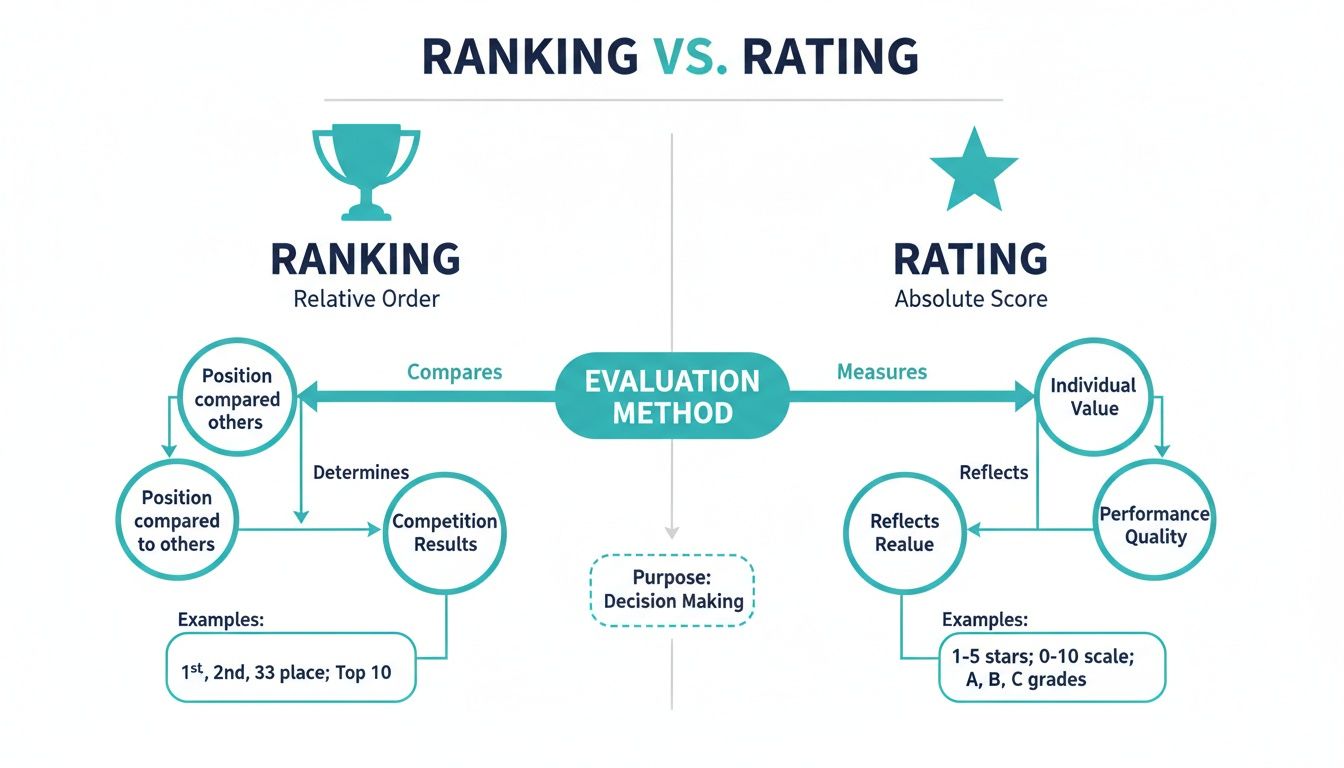
As you can see, ranking creates a direct comparison, forcing a decision. Rating, on the other hand, lets each item exist in its own bubble. That distinction is everything when it comes to making smart, strategic moves.
A rank order scale doesn't just measure what people like; it measures what they choose. It turns vague sentiment into an actionable list of priorities, making it an essential tool for any team that needs to make confident, data-backed decisions.
Ranking vs. Rating: What’s the Real Difference?

To get truly useful feedback, you have to understand the crucial difference between ranking and rating. On the surface, they seem like they do the same job, but they actually measure two very different things. A rating scale tells you the intensity of someone's feelings about a single item, while a rank order scale reveals its relative importance when compared to other items.
Let’s say a product team is trying to decide which of five new features to build next. If they use a simple 1-to-5 star rating scale, they might discover that all five features get an average of 4 stars. That’s great, but it’s not very helpful. If everything is a priority, then nothing is. The team is stuck.
This is exactly where a rank order scale shines.
Forcing a Clear Hierarchy
Instead of just rating, the team asks users to rank the five features from #1 (most wanted) down to #5 (least wanted). This simple switch forces a decision. The ambiguity is gone. Suddenly, you have a clear hierarchy that shows you the single most-desired feature, the second most-desired, and so on down the line.
This approach mirrors how people make decisions in the real world. We constantly make trade-offs because we don’t have unlimited time, money, or attention. A rank order scale captures that process, giving you insights that are far more direct and practical.
By forcing a choice, ranking cuts through polite but unhelpful feedback. It doesn’t just tell you what people like; it tells you what they would choose when they can't have it all.
This helps avoid the trap of collecting feedback that looks positive but gives you no real direction. A great real-world example is the points-based advancement system being introduced in the DECODE™ season of 2026 by the FIRST® Tech Challenge. Instead of teams advancing by winning just one award, they earn points across various categories. This system essentially ranks teams based on a complete view of their performance, prioritizing well-roundedness over a single great achievement.
The Power of Ordinal Data
Rank order scales are a staple in survey design because they produce ordinal data. This just means the data tells you the order of things, but not the specific gap between them. You know that #1 is preferred over #2, but you don't know by how much.
This is the same principle behind the incredibly popular Likert scale, which shows up in many customer experience studies around the globe. You can dive deeper into how statistical ranking methods are used in research) to see just how widespread this concept is.
Ultimately, choosing the right tool for the job is what matters. When you need to know how satisfied someone is with one specific thing, a rating scale is perfect. But when you have to make a tough call between competing priorities, a rank order scale delivers the clarity you need to move forward with confidence.
When To Use A Rank Order Scale
Knowing what a rank order scale is is one thing, but knowing when to pull it out of your toolkit is where the real magic happens. This method is your best bet when you need to cut through vague feedback and find out what people truly prefer. It forces a choice, which is exactly what you need when making tough strategic decisions.
Think about it. You're always working with limited resources—be it time, money, or people. A rank order scale gives you the hard data you need to confidently decide where to focus. It stops you from falling into the "everything is a high priority" trap that stalls so many projects.
Feature Prioritization For Product Teams
If you're on a product team, you know the struggle: what do we build next? Your backlog is probably overflowing with great ideas, and if you used a simple rating scale, you might find that your users "like" five different features equally. That doesn't help you one bit.
This is where a rank order scale becomes a game-changer. By asking users to rank a shortlist of potential features, you get instant clarity.
- Pinpoint the #1 Must-Have: You'll immediately see which feature will make the biggest impact for the most users.
- Build a Smarter Roadmap: Your development plan becomes a direct reflection of user demand, not just internal hunches.
- Align Your Stakeholders: You can use real data to explain why one feature is getting built before another, keeping everyone on the same page.
Identifying Resonant Marketing Messages
For marketers, the goal is always to find the message that sticks. What actually motivates your audience? Is it the price? The quality? The customer service? A rank order scale helps you find out which value proposition lands with the most punch.
Imagine asking your customers to rank what's most important to them when choosing a brand like yours:
- Innovative Technology
- Exceptional 24/7 Support
- Affordable Pricing
- Eco-Friendly Practices
- Sleek Product Design
The results give you a clear playbook for your next campaign. You'll know exactly which message to lead with in your ads, your emails, and on your website. For more ideas on this, take a look at our market research survey templates.
Rank order scales are invaluable for gathering customer preferences and priorities, making them a core tool in understanding and mastering different approaches to Voice of the Customer programs. They help translate broad feedback into a specific action plan.
How to Create Effective Ranking Questions
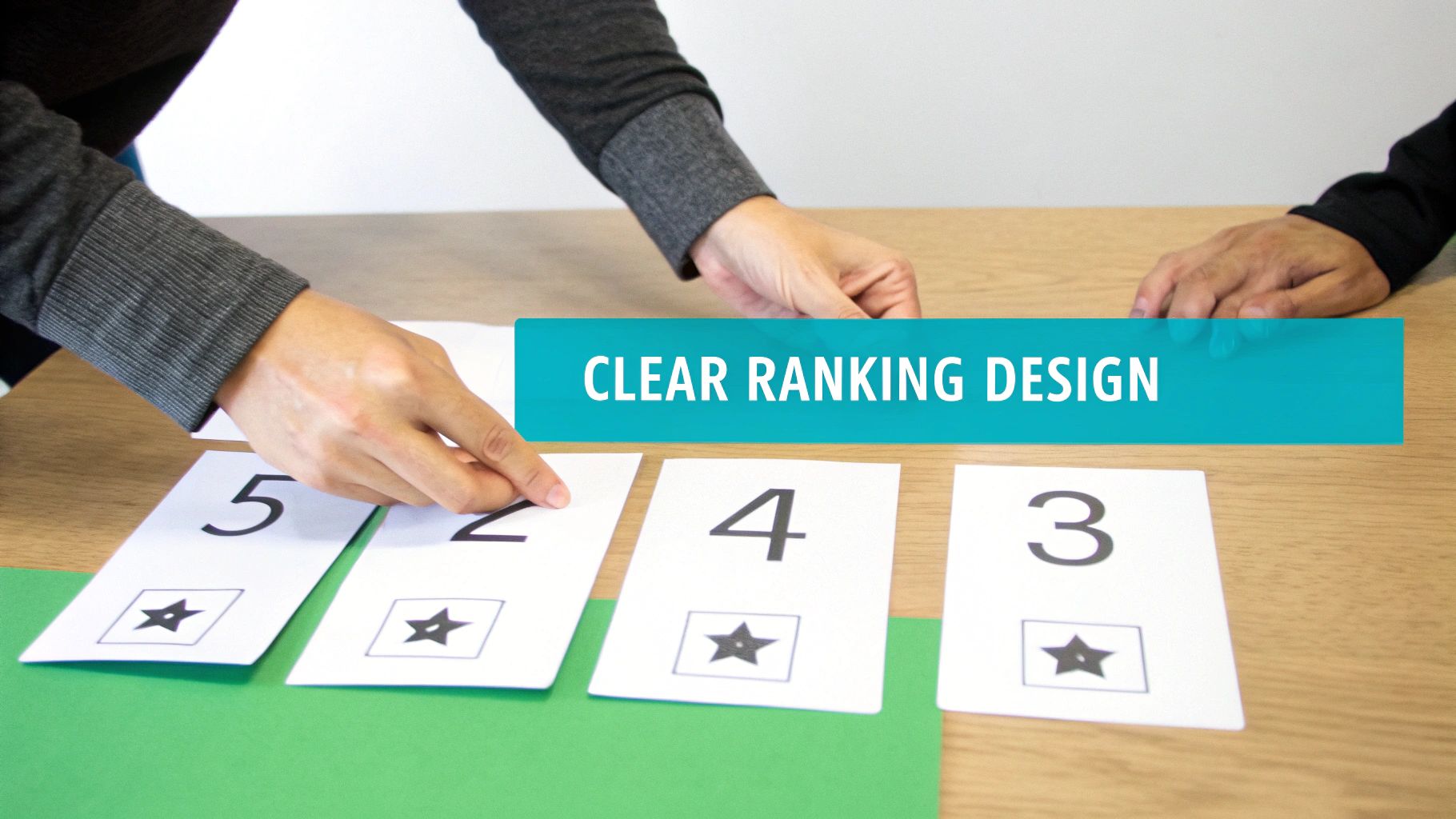
There’s a real art to designing a great ranking question. The quality of the data you get back hinges entirely on how you frame the question and the choices you offer. If you stick to a few key principles, you can build a rank order scale that gives you reliable, sharp insights instead of just a bunch of confusing noise.
These best practices are all about respecting the respondent's attention and mental energy. The goal is to help them give you thoughtful, accurate answers without getting frustrated along the way.
Keep Your Lists Short and Sweet
Probably the most common mistake I see is a list that's just way too long. When someone is staring at ten or more items they need to rank, decision fatigue sets in fast. They might start out carefully considering their choices, but by item six or seven, they’re often just dragging and dropping to get to the end.
The sweet spot for a rank order scale is 5 to 7 items. That’s enough to get meaningful comparative data, but not so much that it overwhelms the person answering. A shorter list ensures every single item gets the consideration it deserves.
If you absolutely must test a longer list of options, it’s much better to split it into a few smaller, more manageable ranking questions. This keeps your data clean and your respondents happy.
Write Clear and Distinct Options
The items you're asking people to rank need to be clearly different from one another. If your options overlap, you're forcing an impossible choice. Respondents get confused, and the data you collect becomes muddled and pretty much useless.
Think about asking a customer to rank what’s most important to them in a new software subscription. Here’s the difference between a list that causes problems and one that gets you clear answers.
Bad Example (Overlapping Options):
- Price
- Value for Money
- Affordability
- Features
- Ease of Use
Good Example (Distinct Options):
- Upfront Cost
- Long-Term Return on Investment (ROI)
- Number of Included Features
- User-Friendly Interface
- 24/7 Customer Support
The "Good" example works because each option is a distinct concept, making the ranking task straightforward. For more ideas on how to craft great questions, our list of survey question examples is a great resource.
Prevent Order Bias By Randomizing
It's just human nature to pay more attention to the first couple of items in any list. We call this order bias, and it can seriously skew your results by giving an unfair advantage to whatever happens to show up at the top.
The fix is simple: randomize the order of the options for every person who sees your survey. Many modern survey tools allow you to enable this feature with a simple click. By shuffling the list for each respondent, you can be confident that an item's final rank comes from its actual appeal, not just its position on the page.
Using a rank order scale inside a conversational form can be particularly effective on mobile devices, as the interactive format feels more like a natural chat. This approach is widely used in customer feedback systems to improve completion rates and gather higher-quality data.
How To Analyze And Interpret Rank Order Data

Alright, you’ve run your survey and the responses are in. Now you're looking at a pile of individual rankings. The real magic happens when you turn that raw rank order data into a clear, compelling story that shows what your audience truly cares about.
The most common and effective way to do this is with a weighted scoring system. This simple method assigns points to each ranking position, letting you calculate an overall score for every option on your list. You're essentially translating preferences into hard numbers, which makes it easy to see the final hierarchy.
Calculating Weighted Scores
The process itself is surprisingly simple. You just give more points to higher ranks and fewer points to lower ones. This is often called inverse scoring because the #1 rank gets the highest point value.
For example, if you asked people to rank 5 items, your scoring might look like this:
- Rank #1: 5 points
- Rank #2: 4 points
- Rank #3: 3 points
- Rank #4: 2 points
- Rank #5: 1 point
To get the final score for an item, you multiply the number of times it received a certain rank by the points assigned to that rank. Then, you just add up all those totals. This approach is a core part of turning raw numbers into insights—a fundamental concept in any good data collection methodology.
Let’s walk through a quick example. Imagine you surveyed 100 users, asking them to rank five potential new features for your app. After tallying the votes and applying the weighted scores, your analysis comes together in a table.
Sample Rank Order Analysis
Here’s how the data might shake out. This table shows the total score for each feature, calculated by adding up all the weighted rankings from our 100 respondents.
| Feature Option | Total Weighted Score | Final Rank |
|---|---|---|
| Advanced Analytics | 425 | 1 |
| Team Collaboration | 350 | 2 |
| AI Assistant | 290 | 3 |
| Custom Templates | 215 | 4 |
| Offline Mode | 180 | 5 |
Visualizing The Final Hierarchy
See how clear that is? The table instantly reveals the preference hierarchy. In this scenario, "Advanced Analytics" is the undisputed winner, while "Offline Mode" is the lowest priority for this group of users.
This kind of analysis transforms a collection of subjective opinions into a clear, actionable roadmap. It cuts through the guesswork and helps align your entire team around what actually matters to your customers.
Common Questions About Rank Order Scales
Even after you get the hang of rank order scales, a few practical questions always seem to pop up when you're in the thick of designing a survey. Nailing these details is what separates clean, reliable data from a confusing mess. This quick FAQ will tackle those common sticking points and give you the confidence to put these scales to work.
We’ll dig into the most frequent challenges, from figuring out the ideal number of options to really understanding the kind of data you're collecting.
How Many Items Should I Ask Someone to Rank?
The magic number is usually between 5 and 7 items. This range is the sweet spot. It's enough to get meaningful comparative data, but not so much that you overwhelm people.
Once you push past eight items, you run into what's called 'ranking fatigue.' People get tired, stop paying close attention, and just start dragging and dropping things randomly. That kind of sloppy data can tank your results. If you have a long list, your best bet is to break it up into a few smaller, more manageable ranking questions.
What’s the Difference Between Ordinal and Interval Data?
This is a really important distinction, and it's at the heart of how rank order scales work. Ranking gives you ordinal data. All that means is you know the order of things—first is better than second, second is better than third—but you don't know the distance between them. Is the top choice wildly more popular than the runner-up, or just slightly? The ranking alone won't tell you.
Interval data is different; it has equal, known gaps between each value, like degrees on a thermometer. The key takeaway is to never treat your ordinal ranking data like it's interval data during your analysis. Doing so can lead you to completely wrong conclusions about how strong people's preferences really are.
Think of it this way: A rank order scale tells you who won the race, but not by how much. It gives you a clear pecking order, but it doesn't measure the magnitude of preference between each rank.
How Should I Handle a "Not Applicable" or "Don't Know" Option?
Forcing someone to rank something they've never heard of is a surefire way to get bad data. The cleanest way to handle this is with a screening question before the ranking task. For example, ask "Which of these brands have you used in the past year?" first, and then only show them those specific brands to rank.
If that's not an option, use a survey tool that lets people drag and drop only the items they know, leaving the others unranked. The one thing you should never do is add "N/A" as an option in the ranking list itself. It muddies the analysis and can throw off any weighted scores you try to calculate later.
Ready to create engaging surveys that deliver clear, prioritized insights? Formbot's conversational forms make it easy to build surveys with powerful rank order scale questions. Turn feedback collection into a seamless experience and start making smarter, data-driven decisions today. Start building for free at tryformbot.com.