The event is over, the booths are packed up, and the last of the coffee has been cleared away, but your most important work is just beginning. Gathering feedback is crucial for measuring success and planning future improvements, but asking generic questions yields generic, unhelpful answers. To truly understand your event's impact, improve future experiences, and demonstrate clear ROI, you need a strategic approach to your post-event survey questions.
This guide provides a comprehensive collection of questions across 8 essential categories, designed to give you specific, actionable insights. We will move beyond simple satisfaction scores to explore nuanced queries about content quality, speaker performance, logistical execution, and overall value. By asking the right post-event survey questions in 2026, you can uncover what truly resonated with your audience and identify precise areas for improvement. A well-crafted survey is the bridge between one-off attendees and a loyal, engaged community.
We'll cover not only what to ask but also how to ask it, including recommended response formats and best practices for phrasing. To streamline this process and efficiently gather attendee perspectives, many event organizers utilize platforms offering comprehensive guest WiFi survey functionality, which can capture feedback in real-time. This article will equip you with the tools needed to turn attendee feedback from a simple report card into your most valuable strategic asset, ensuring every future event is better than the last.
1. Overall Event Satisfaction
The overall event satisfaction question is the cornerstone of any post-event survey. It acts as a high-level barometer, providing a quick and clear signal of whether your event hit the mark with attendees. By asking for a general rating on a numeric scale (e.g., 1-5 or 1-10) or a sentiment scale (e.g., Very Dissatisfied to Very Satisfied), you establish a crucial baseline metric. This single data point is invaluable for tracking event performance over time and justifying ROI to stakeholders and sponsors.
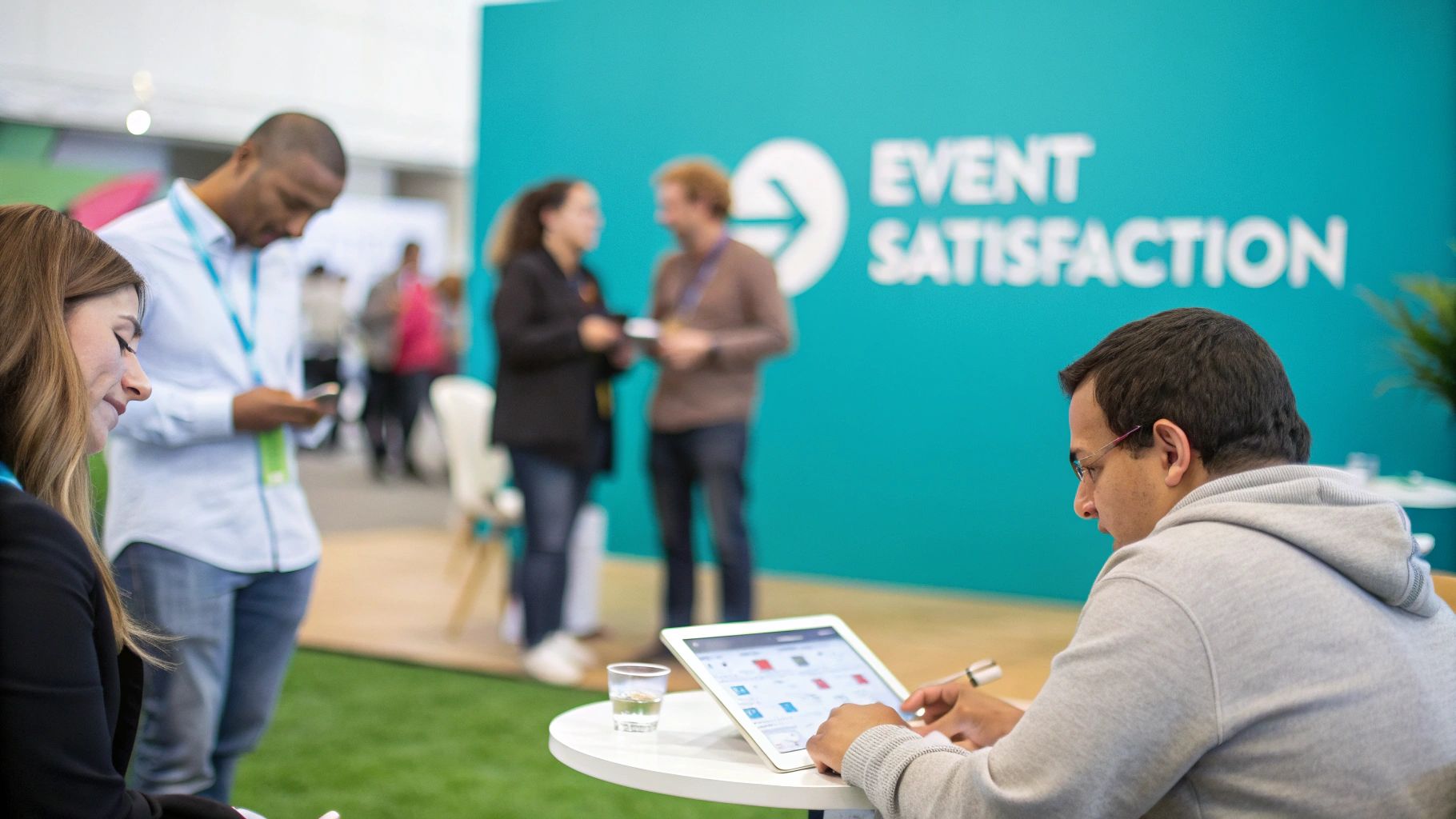
Think of this question as the primary KPI for your event's success. Major platforms like Eventbrite use it as a core feedback metric, and it’s a standard opening question in most professional survey templates for a reason: it immediately segments your audience into promoters, passives, and detractors. This allows you to tailor the rest of the survey experience for more targeted and relevant feedback.
How to Implement This Question
To get the most out of this question, placement and follow-up are key. It should be one of the very first post-event survey questions you ask.
- Placement: Position this question at the beginning of your survey. An attendee’s initial, unfiltered reaction is often the most honest.
- Response Scale: Use a simple and universally understood scale. A 5-point Likert scale ("Very Dissatisfied" to "Very Satisfied") or a 1-10 numerical scale are both effective choices.
- Conversational Tone: When using a tool like Formbot, phrase the question naturally to boost engagement. For example, a chat-based prompt like, "Overall, how would you rate your experience at our 2026 conference?" feels more personal than a static form field.
Pro Tip: Use conditional logic based on the satisfaction score. If a user provides a low score (e.g., 1 or 2 out of 5), automatically route them to an open-ended question asking for specific feedback on what could be improved. For high scores, you could ask what they enjoyed most or request a testimonial.
This approach not only gathers quantitative data but also uncovers the qualitative "why" behind the score. By tracking this core metric in your analytics dashboard, you can measure the impact of changes year-over-year and continuously refine your event strategy. This aligns with broader strategies for improving the attendee journey, an important part of any great customer experience survey.
2. Content Relevance and Quality
While overall satisfaction provides a high-level view, understanding content performance is crucial for educational events, conferences, and webinars. This question category drills down into whether your sessions, workshops, and speakers met the professional needs and expectations of your audience. Gauging content relevance is essential for validating your content strategy and informing the agenda for future events, ensuring you consistently deliver value.
This focus on content is a key differentiator for industry-leading events. Conferences organized by HubSpot and marketing leaders like Moz scrutinize session relevance to optimize their programming. Similarly, platforms like LinkedIn Learning rely heavily on content quality ratings to refine their course offerings. This data helps them understand which topics resonate most, which speakers are most effective, and what content gaps need to be filled.
How to Implement This Question
To gather meaningful feedback on content, your questions must be specific and well-timed. Asking attendees to recall every session at once can lead to survey fatigue and inaccurate responses.
- Placement: Ask about specific sessions immediately after general satisfaction questions. Use a one-question-at-a-time flow to avoid overwhelming the user.
- Response Scale: A 5-point Likert scale ("Not at all relevant" to "Extremely relevant") works well for individual sessions. You can also use a simple star rating.
- Smart Logic: Implement smart branching to only ask attendees about the specific sessions they actually attended. This personalization makes the survey more relevant and boosts completion rates.
- Conversational Tone: Frame your questions in a natural way. A prompt like, "How would you rate the relevance of the 'Future of AI in Marketing' session to your role?" feels more engaging than a generic form field.
Pro Tip: Follow up a quantitative rating question with an open-ended one. After a user rates a session, ask, "What topics would you like to see covered at our next event?" This provides actionable guidance for your next content calendar. Segmenting these results by job role will reveal what content different audience personas value most.
Analyzing content feedback is fundamental to event growth and retention. By understanding what your audience wants to learn, you can build a reputation for delivering exceptional value year after year. For more tips on phrasing, explore these guidelines on how to write effective survey questions.
3. Likelihood to Recommend (Net Promoter Score)
The Net Promoter Score (NPS) question, "How likely are you to recommend this event to a friend or colleague?" is a powerful, industry-standard metric for gauging attendee loyalty and word-of-mouth potential. It goes beyond simple satisfaction to measure advocacy, segmenting your audience into Promoters, Passives, and Detractors based on their score on a 0-10 scale. This provides a clear, single number that quantifies your event's growth potential.
This question is essential for understanding if your event created true fans who will actively help you grow. Major global events, from Salesforce's customer summits to Amazon's AWS conferences, rely on NPS as a core success metric. It shifts the focus from a one-time experience to long-term brand loyalty, making it one of the most strategic post-event survey questions you can ask.
How to Implement This Question
To effectively use NPS, you need to ask it correctly and, more importantly, act on the results. It should be asked early in your survey before respondent fatigue can influence the score.
- Placement: Position the NPS question right after the overall satisfaction query. This captures a high-level loyalty metric before diving into more granular details.
- Response Scale: Always use the standard 0-10 scale, where 0 is "Not at all likely" and 10 is "Extremely likely". This standardization is crucial for calculating your score and benchmarking it.
- Crucial Follow-Up: The real value of NPS comes from the follow-up. Always ask, "What is the primary reason for your score?" This open-ended question uncovers the specific drivers behind the number.
Pro Tip: Leverage conditional logic to dig deeper into the NPS score. With a tool like Formbot, you can automatically present different follow-up questions. For detractors (0-6), ask, "We're sorry we didn't meet your expectations. What is one thing we could do to improve for next year's event?" For promoters (9-10), ask, "We're thrilled you enjoyed it! Would you be willing to provide a brief testimonial?"
This segmented approach turns your survey into a powerful engine for gathering targeted improvement feedback and marketing assets. By tracking your NPS over time in an analytics dashboard, you can measure the direct impact of your event enhancements and learn more about how to improve your NPS score.
4. Event Organization and Logistics
Flawless execution is the invisible framework that holds a great event together. Questions about event organization and logistics evaluate this operational backbone, from the first touchpoint at registration to the final session's technical setup. This feedback measures how smoothly the event ran and whether logistical elements supported a positive attendee experience. Gathering these insights is critical for operations teams and event planners to prevent friction points that can detract from an otherwise excellent program.
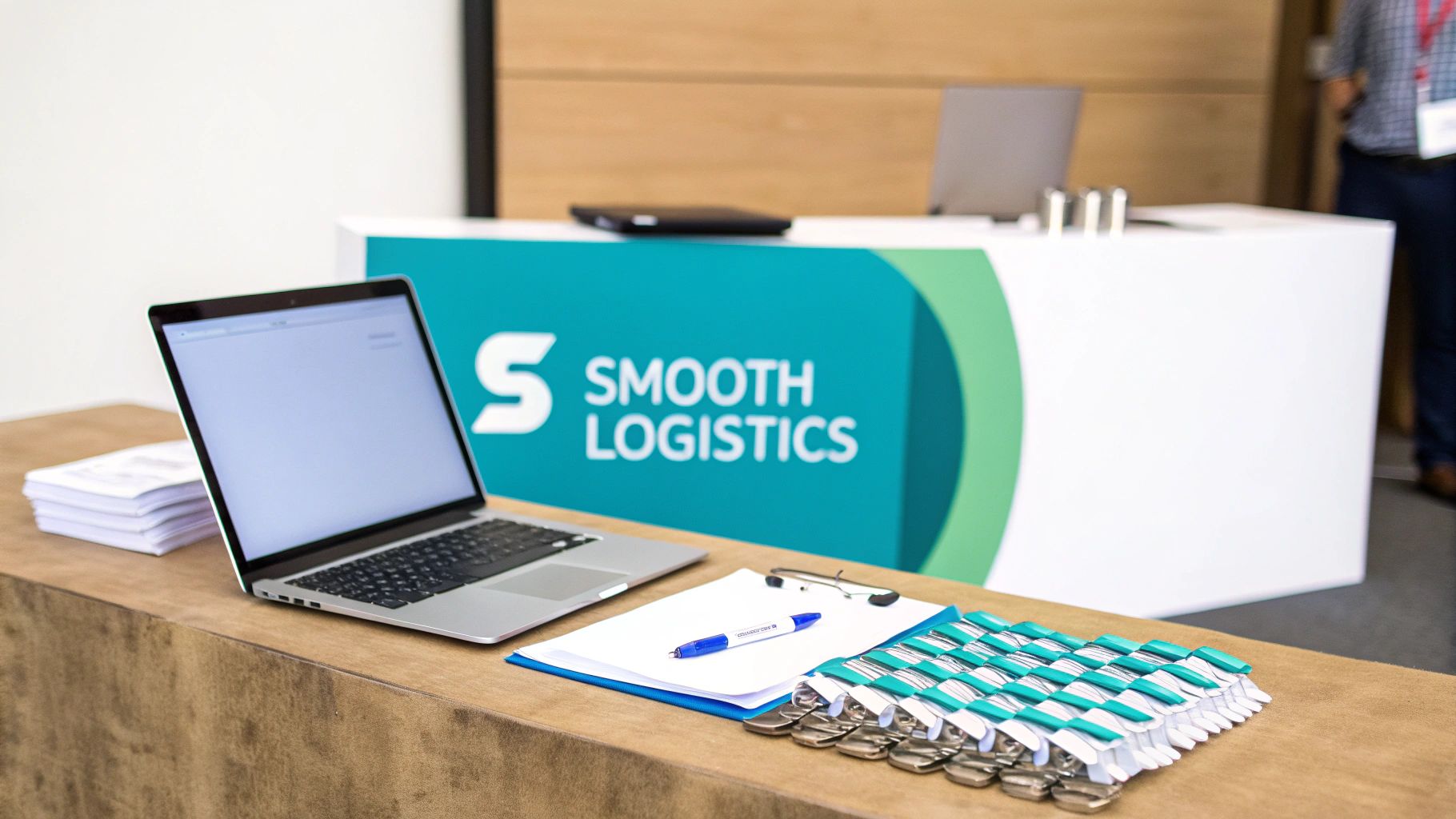
Think of these questions as your operational audit. Major events like SXSW rely on this feedback to manage venue flow and scheduling, while corporate offsites use it to optimize check-in speed and room coordination. The data collected directly informs your event playbook, helping you replicate successes and eliminate bottlenecks for future events. This is one of the most actionable categories of post-event survey questions because it points to tangible, fixable issues.
How to Implement This Question
To get meaningful data, avoid a single "How were the logistics?" question. Instead, break it down into specific, measurable components.
- Categorize Your Questions: Group questions by logistical area: registration, venue (e.g., navigation, cleanliness), scheduling, food and beverage, and technical support. This makes the survey easier to answer and your data cleaner to analyze.
- Use Rating Scales: For each category, use a satisfaction scale (e.g., "Poor" to "Excellent"). This allows you to quickly spot which logistical areas underperformed.
- Conversational Probing: A chat-based survey can make this feel less like an interrogation. For example, a prompt like, "How was the check-in process at our 2026 conference?" is a natural way to begin this section.
Pro Tip: Use an open-ended follow-up question to capture the specifics. After a series of ratings, simply ask, "Is there any specific logistical feedback you'd like to share that could help us improve next year?" This is where you'll uncover invaluable details, like a confusing sign or a slow Wi-Fi connection in a specific breakout room.
By dissecting your event's operational performance, you gather the precise feedback needed to make iterative improvements. Identifying patterns, such as all complaints being tied to a specific catering choice or registration desk, allows for targeted problem-solving that significantly elevates the attendee experience in the future.
5. Networking and Community Building
For many attendees, particularly at professional conferences and B2B events, the quality of networking is just as important as the content presented. This question assesses your event's effectiveness in facilitating meaningful connections, strengthening professional networks, and fostering a sense of community. It helps you understand if you provided the right environment and tools for attendees to connect, which is a primary driver of perceived event value and a key reason people return year after year.

Think of this question as a measure of your event's "social ROI." Major industry events and platforms like LinkedIn Events recognize that the number and quality of connections made are critical success metrics. A strong networking experience transforms a passive listening event into an active, community-building one. The feedback gathered here directly informs your strategy for future networking sessions, icebreakers, and social mixers.
How to Implement This Question
To effectively gauge networking success, you need to ask questions that go beyond a simple "yes" or "no." Specificity is crucial for generating actionable insights.
- Placement: Ask networking-related questions after general satisfaction but before drilling down into specific content sessions. This keeps the focus on the overall attendee experience.
- Response Scale: Start with a direct question like, "How would you rate the networking opportunities at the event?" on a 1-5 scale. Follow this with questions about specific activities (e.g., "Which of the following networking activities did you find most valuable?").
- Conversational Tone: Use a friendly, direct prompt to encourage honest feedback. A chat-based survey might ask, "Did you make any valuable professional connections at our 2026 summit?" This feels more personal and can lead to more detailed qualitative answers.
Pro Tip: Segment your audience to uncover deeper insights. Ask first-time attendees how well the event helped them integrate into the community, while asking repeat attendees if they were able to deepen existing relationships. This allows you to tailor future networking formats to different audience needs.
By analyzing responses to these post-event survey questions, you can identify which networking formats (e.g., structured speed networking, casual mixers, app-based matchmaking) resonate most with your audience. This data empowers you to optimize the social architecture of your future events, ensuring they are not just informative but also transformative for building professional communities.
6. Value for Time and Money Investment
This question directly addresses the attendee's perceived return on investment (ROI). For many, particularly in a B2B context, attending an event involves a significant commitment of both time away from work and financial resources. Asking about the value received for this investment is crucial for understanding if your event's content, duration, and pricing are correctly aligned with attendee expectations. This metric is a powerful predictor of future attendance and loyalty.
Gauging the perceived ROI helps you justify ticket prices and demonstrate value to corporate decision-makers who approve employee attendance. For premium conferences or corporate training events, a strong positive response to this question is a key performance indicator. It tells you whether the knowledge, networking opportunities, and overall experience provided a tangible benefit that outweighed the cost, making it one of the most critical post-event survey questions for business-focused gatherings.
How to Implement This Question
To get an accurate picture of perceived value, you need to ask this question directly and be prepared to dig into the reasoning behind the answer.
- Placement: Ask this after general satisfaction but before detailed questions on specific sessions. This positions it when the attendee is thinking about the event's overall impact.
- Response Scale: A 5-point Likert scale ranging from "Poor value" to "Excellent value" works well. You can also use a simple "Yes/No" for a question like, "Was the event worth the cost of registration?"
- Conversational Tone: Using a tool like Formbot, a friendly prompt can yield more thoughtful responses. For example, "Thinking about what you paid to attend, how would you rate the overall value of the 2026 summit?" feels more engaging.
Pro Tip: Segment the responses by ticket type or attendee demographic. You may find that attendees on a VIP pass perceived excellent value, while those on a general admission ticket did not. This insight allows you to adjust pricing tiers or enhance the benefits for different attendee groups in the future.
By analyzing responses to this question, you can make data-driven decisions about your event's structure, content strategy, and pricing model. If value perception is low, a follow-up question asking what would have increased the value is essential for identifying specific areas for improvement, ensuring your next event delivers an even better ROI for every attendee.
7. Likelihood of Future Attendance
This question directly measures an attendee's intent to return, acting as a powerful leading indicator for future event success and sustainability. It goes beyond immediate satisfaction to gauge loyalty and helps you understand whether you are building a dedicated community or constantly need to acquire new audiences. For recurring events like Dreamforce or TechCrunch Disrupt, this metric is critical for forecasting, resource allocation, and proving long-term value.
Understanding return intent has significant implications for your marketing strategy and budget. A high likelihood of future attendance signifies a strong, loyal base, allowing you to focus marketing efforts on engagement and upselling. Conversely, low intent signals potential issues with the event's core value proposition, content, or overall experience, indicating a need to invest more in acquisition and retention strategies for the following year.
How to Implement This Question
To effectively measure future attendance intent, the question should be direct but also open the door to uncovering potential barriers. It's a key part of your post-event survey questions that informs strategic planning.
- Placement: Ask this question after general satisfaction but before drilling down into niche topics. It logically follows the "How was it?" line of questioning.
- Response Scale: A simple "Yes/No/Maybe" provides a clear, quantitative measure. You can also use a 5-point likelihood scale from "Very Unlikely" to "Very Likely" for more nuanced data.
- Conversational Tone: Frame the question in a way that feels natural and forward-looking. A chat-based prompt like, "Would you attend another one of our events in the future?" or "Are you planning to join us for the 2027 summit?" is more engaging.
Pro Tip: Implement conditional logic to dig deeper into the "why." If a user responds with "No" or "Maybe," immediately trigger a follow-up question asking, "What, if anything, would prevent you from attending again?" This uncovers specific barriers-like cost, location, timing, or content relevance-that you can actively address.
This approach not only provides a forecast but also creates a direct feedback loop for improvement. By segmenting attendees based on their responses, you can create targeted re-engagement campaigns for the "Maybes" and address the concerns of the "Nos," turning potential churn into an opportunity for growth and refinement.
8. Specific Feedback on Speakers and Sessions
While a general content question gives you a broad overview, asking for specific feedback on speakers and sessions provides the granular data needed to elevate future event programming. This question drills down into the performance of individual presenters and the value of specific sessions, moving beyond general relevance to evaluate delivery, engagement, and expertise. This feedback is indispensable for curating your speaker lineup, refining session formats, and ensuring your content truly resonates with your audience.
Think of this as your quality control mechanism for event content. Major events like the Gartner Symposium rely on session-by-session evaluations to maintain their reputation for high-value analysis, while TED meticulously rates speaker performance to inform future invitations. By collecting this data, you can identify your star performers, understand which topics need a more dynamic presenter, and make data-driven decisions about your content strategy for the next event.
How to Implement This Question
To gather effective speaker feedback, you need a smart, targeted approach that doesn't overwhelm attendees. The key is to ask only about the sessions they actually attended.
- Placement: Introduce these questions after general satisfaction queries but before logistical feedback. This keeps the focus on the core content experience.
- Targeted Questioning: Use registration data to only show evaluation questions for sessions an attendee was checked into. This personalization prevents survey fatigue and improves data accuracy.
- Conversational Flow: A tool like Formbot can make this process seamless. For instance, start with a conversational prompt like, "Great! I see you attended three sessions. Let's start with 'The Future of AI in Marketing'. How would you rate the speaker's delivery on a scale of 1-5?" This guides the user through the evaluation one step at a time.
- Specific Criteria: Instead of a single "rate this session" question, break it down into key criteria. Ask attendees to rate speakers on expertise, engagement/presentation style, and clarity of the material.
Pro Tip: Combine quantitative ratings with qualitative follow-ups. After a rating, ask an open-ended question like, "What was the single most valuable takeaway from this session?" or "Is there anything the speaker could have done to improve your experience?" This uncovers the "why" behind the scores. Also, consider adding a question like, "Who was your favorite speaker at the event?" to easily identify audience champions.
8-Point Post-Event Survey Comparison
| Item | Implementation Complexity 🔄 | Resource Requirements ⚡ | Expected Outcomes 📊 | Ideal Use Cases 💡 | Key Advantages ⭐ |
|---|---|---|---|---|---|
| Overall Event Satisfaction | 🔄 Low — single 1–10 or 1–5 rating, optional branching | ⚡ Minimal — one question, easy to collect | 📊 High-level satisfaction baseline; trendable | 💡 Quick pulse checks; survey opener; benchmarking | ⭐ High completion, easy comparison over time |
| Content Relevance and Quality | 🔄 Medium — session-specific items and conditional logic | ⚡ Moderate — segmentation and qualitative coding | 📊 Clear signals on content fit and learning gaps | 💡 Content strategy, speaker selection, educational events | ⭐ Directly informs programming and ROI |
| Likelihood to Recommend (NPS) | 🔄 Low–Medium — single 0–10 item + follow-ups | ⚡ Low — standardized scoring; follow-up needed for action | 📊 Predicts growth/advocacy; promoter/detractor segmentation | 💡 Loyalty benchmarking; advocacy and retention planning | ⭐ Strong predictor of event growth and reputation |
| Event Organization and Logistics | 🔄 Medium — multiple dimensions (registration, venue, tech) | ⚡ Moderate — requires per-area tracking and vendor input | 📊 Actionable ops improvements; vendor performance insights | 💡 Operational reviews, hybrid/in-person logistics checks | ⭐ Directly actionable to improve attendee experience |
| Networking and Community Building | 🔄 Medium — asks about formats attended and outcomes | ⚡ Moderate — tracks activities, follow-ups, long-term impact | 📊 Measures networking effectiveness and connection value | 💡 B2B conferences, community-driven events, matchmaking | ⭐ Drives business outcomes and differentiates events |
| Value for Time and Money Investment | 🔄 Low–Medium — separate time vs. money questions recommended | ⚡ Moderate — segment by ticket tier, analyze perceptions | 📊 Insights on perceived ROI; pricing and duration guidance | 💡 Paid events, corporate training, pricing strategy reviews | ⭐ Tied to repeat attendance and pricing decisions |
| Likelihood of Future Attendance | 🔄 Low — yes/no/maybe with conditional probes | ⚡ Low — simple to collect; needs follow-up for barriers | 📊 Leading indicator of retention and event-market fit | 💡 Forecasting attendance, retention strategy, budgeting | ⭐ Clear signal of loyalty and program sustainability |
| Specific Feedback on Speakers and Sessions | 🔄 High — per-session ratings can cause survey fatigue | ⚡ High — requires filtering by attended sessions and rich analysis | 📊 Detailed speaker performance metrics; session-level actions | 💡 Speaker-driven conferences, training programs, session design | ⭐ Identifies standout speakers and improves delivery quality |
From Data to Decisions: Making Your Feedback Actionable
You've now explored a comprehensive arsenal of post-event survey questions, from high-level satisfaction metrics like NPS to granular inquiries about speaker performance and logistical execution. But the journey doesn't end when the last response is submitted. In fact, that’s precisely where the most critical work begins. Collecting feedback is merely the first step; the real transformation happens when you translate that raw data into a strategic roadmap for future success. The power of these questions lies not in asking them, but in acting upon the answers you receive.
Your post-event survey is more than a report card, it's a blueprint for growth. By thoughtfully selecting and sequencing your questions, you create a powerful feedback loop that informs every aspect of your event strategy, from content programming and venue selection to sponsorship packages and marketing messaging. This process turns a one-time event into a long-term community-building engine.
Turning Insights into Actionable Strategy
The core challenge is moving from a spreadsheet of responses to tangible improvements. The key is to systematize your analysis and create a clear action plan. Don't let valuable feedback languish in a forgotten folder.
- Segment Your Data: Break down responses by attendee demographics, ticket type, or first-time vs. returning guests. This can reveal that first-time attendees struggled with navigation while veteran attendees found the content too basic, allowing you to tailor future experiences for different groups.
- Identify Key Themes: Look for recurring patterns across both quantitative and qualitative feedback. If multiple attendees mention long registration lines or praise a specific networking format, those are clear signals for what to fix and what to double down on. For open-ended questions, understanding how to effectively analyze qualitative data is key to extracting these deeper, more nuanced insights.
- Prioritize and Assign Ownership: You can't fix everything at once. Create a prioritized list of action items based on impact and feasibility. Assign each item to a specific team member or department to ensure accountability and follow-through. For instance, feedback on session quality goes to the content team, while comments on catering are routed to the operations lead.
The Continuous Improvement Cycle
The ultimate goal is to create a virtuous cycle where each event builds upon the successes and learnings of the last. By consistently asking the right post-event survey questions and acting on the feedback, you demonstrate a genuine commitment to your audience. This commitment fosters loyalty, boosts your event's reputation, and transforms attendees into dedicated advocates.
This process ensures that your events evolve and adapt to meet the ever-changing needs of your community. It’s how you go from hosting a good event in 2026 to hosting an unmissable, industry-leading experience in the years to come. Your attendees are your most valuable consultants, offering a wealth of strategic insights for the simple price of being heard. Listen intently, act decisively, and you will build a legacy of events that not only meet expectations but consistently exceed them. The data is your guide; let it lead you to exceptional results.
Ready to transform your feedback process with surveys that attendees actually complete? Formbot helps you build beautiful, conversational forms and surveys that can boost completion rates. Start collecting higher-quality data today by signing up at Formbot.